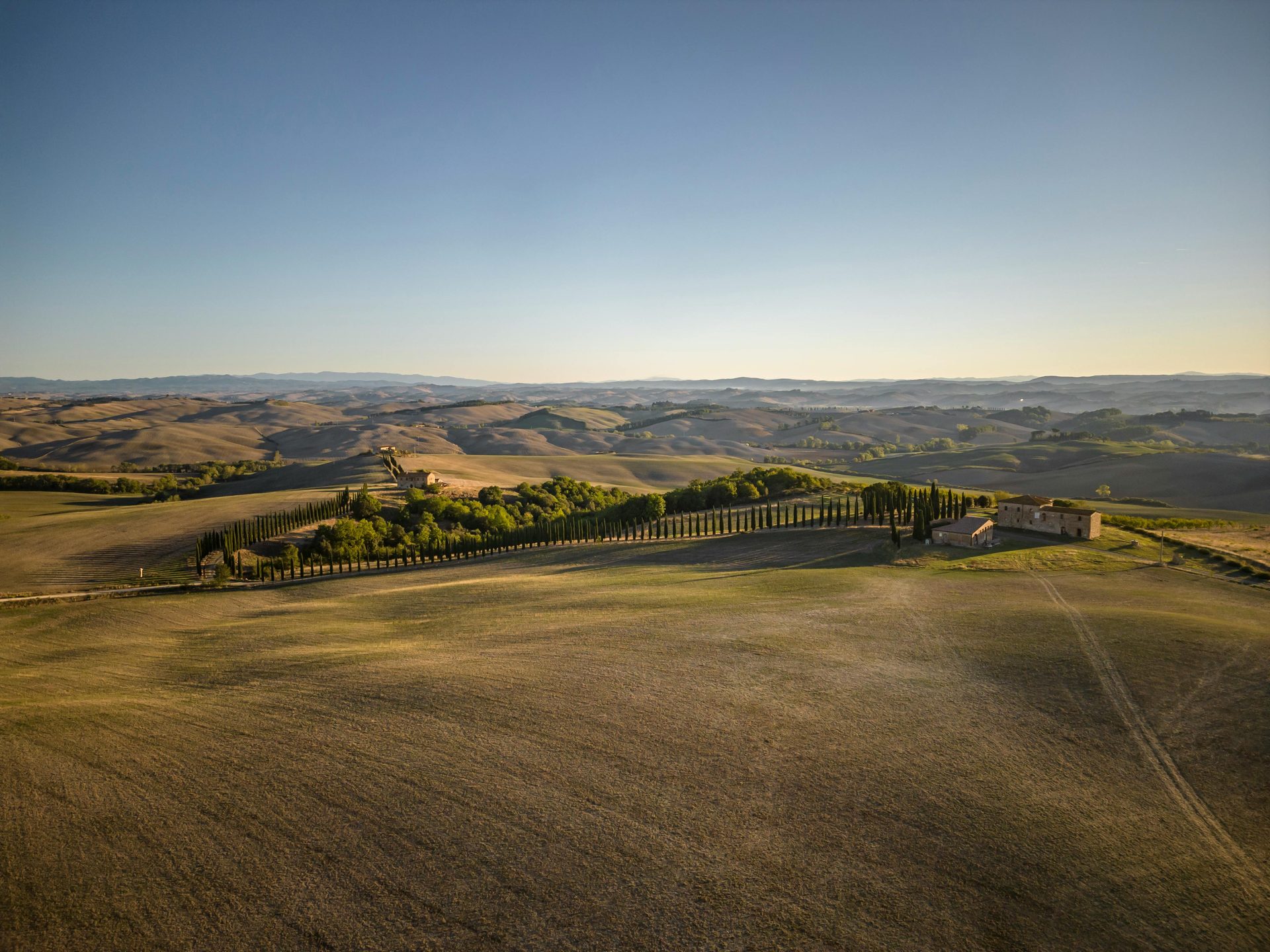
Tuscany has no single property market. The gap between a farmhouse in the Garfagnana and a villa in Forte dei Marmi runs to a factor of twenty-two in price per square metre, and meaningful differences exist within single zones. The figures in this report draw on transaction data and public market sources, including OMI data from the Agenzia delle Entrate. As of July 2026.
What does property cost in Tuscany in 2026?
The range spans roughly 1,000 EUR per square metre in the Garfagnana to over 22,000 in Forte dei Marmi. A restored farmhouse in the Chianti Classico sits at 3,500 to 5,500 EUR per square metre.
| Region | Segment | Price range EUR/sqm | YoY trend |
|---|---|---|---|
| Chianti Classico | Restored farmhouse | 3,500-5,500 | stable |
| Val d'Orcia | Restored farmhouse | 2,300-3,300 | rising demand |
| Versilia / Forte dei Marmi | Villa / apartment | 10,065-22,000 | rising sharply |
| Maremma coast | Villa | 3,350-5,750 | rising |
| Maremma inland | Farmhouse | ~1,570 | softening |
| Florence centro | Luxury apartment | 8,500-15,000 | rising |
| Fiesole | Villa | 4,000-8,000+ | stable |
| Lucca centro | City apartment | 3,575-3,659 | rising |
| Garfagnana | Farmhouse / rustico | 1,000-1,300 | easing slightly |
Tuscany remains the region international buyers ask about most. For buyers who prefer a clean legal slate over a restoration project, new-build villas represent a small but growing share of the market, mostly on the edges of towns where planning rules permit them.
Chianti Classico: 3,500-5,500 EUR/sqm for restored farmhouses
A restored farmhouse with a pool in the Chianti Classico trades between 1.2 and 3.5 million EUR. Unrenovated farmhouses cost 400,000 to 1.2 million. Villas start at 2.5 million. Wine estates (tenute) with production start at 3.5 million.
| Type | Price range | EUR/sqm |
|---|---|---|
| Restored farmhouse + pool | 1.2-3.5M EUR | 3,500-5,500 |
| Unrenovated farmhouse | 400k-1.2M EUR | 1,000-2,000 |
| Villa | 2.5-7.5M EUR | 2,800-5,000 |
| Estate with production | 3.5-11M+ EUR | varies |
The sub-zones carry real price differences. Ranked by level, Panzano and southern Greve in Chianti sit highest, followed by Castellina, Radda, Gaiole, Barberino Tavarnelle and San Casciano Val di Pesa. The gap between Panzano and Gaiole runs to several hundred EUR per square metre.
German-speaking buyers were historically the strongest group in the Chianti. German enquiries softened through 2025. US buyers have since become one of the strongest source markets, which is why where to buy in Tuscany reads differently from three years ago.
The Chianti is stable, and it has been fully discovered. Part of what a buyer pays for is the address. Buyers who want comparable landscape at better value find it in the Val d’Orcia or in the zone around San Gimignano and Volterra.
Val d’Orcia: UNESCO-protected and noticeably cheaper than the Chianti
A restored farmhouse in the Val d’Orcia costs 1.2 to 2.5 million EUR, well below the Chianti at equivalent quality. Unrenovated properties run 300,000 to 500,000. Pienza averages roughly 2,982 EUR/sqm; Montalcino averages about 2,347 EUR/sqm (OMI).
The UNESCO designation works in both directions. It supports long-term values and limits what a buyer can change. Permits take longer here than in the Chianti, so a restoration project needs additional time budgeted for approvals. Good properties under 1.5 million are becoming scarce in Pienza and Montalcino; demand has picked up. The full picture, including what the designation means for permits, is in the Val d’Orcia property guide.
Versilia and the coast: Forte dei Marmi as its own market
The Versilia coast is a villa-and-apartment market on the Tyrrhenian Sea, with no farmhouses and no olive groves. It runs on different fundamentals from inland Tuscany.
Forte dei Marmi averages 10,065 to 11,500 EUR/sqm. The Roma Imperiale neighbourhood runs 14,000 to 22,000, with ultra-prime transactions reaching 40,000. Values have risen sharply in recent years. Buyers here purchase an address rather than a yield-generating asset; the investment logic differs from the inland casale. The full breakdown of neighbourhoods and what drives prices at the top end is in the Versilia and Forte dei Marmi property guide.
Viareggio’s Lungomare sits at about 5,200 EUR/sqm. Pietrasanta ranges from 2,900 to 8,600 depending on location.
Maremma: expensive coast, much cheaper inland
The Maremma splits between a coast that is no longer inexpensive and an interior that still offers considerable value per euro.
| Location | EUR/sqm | Trend |
|---|---|---|
| Monte Argentario | 3,350-5,750 | rising |
| Castiglione della Pescaia | 3,765-4,720 | rising |
| Capalbio | 3,845-4,440 | stable |
| Scansano (inland) | ~1,570 | softening |
The coastal gap is substantial. Scansano inland sits at roughly 1,570 EUR/sqm and is softening. Inland farmhouses there cost 600,000 to 2 million EUR, which buys considerably more substance per euro than the coastal alternatives. Buyers looking for an agriturismo or a wine property find more land per euro in the Maremma than in the Chianti.
Florence and Fiesole: city apartments from 4,500 EUR/sqm
Florence is among Italy’s most active property markets. The city average stands at 4,500 to 4,700 EUR/sqm. The Centro Storico averages 5,300 to 6,200. Luxury apartments run 8,500 to 12,000, and ultra-prime reaches 15,000.
Fiesole, the hillside above the city, ranges from 4,000 to 8,000+ EUR/sqm, with villas priced from 1 to 12 million EUR. Bagno a Ripoli to the south-east averages about 3,438 EUR/sqm.
For buyers who want a city flat rather than a country estate, Florence is the natural starting point. Buyers who want a rural property but price it in Florence per-square-metre terms tend to overpay. The neighbourhoods, hillside positions and price detail are in the Florence and Fiesole property guide.
Lucca and Garfagnana: steady gains over the past five years
Lucca concentrates luxury stock in the 1 to 3 million EUR range. Centro Storico sits at 3,575 to 3,659 EUR/sqm. The Colline Lucchesi, known for historic villas with Italian gardens and views to the city, run 2,000 to 4,500.
Lucca has outpaced the Chianti over five years. Long under the radar for non-Italian buyers, it increasingly attracts buyers for whom the Chianti is fully priced. The combination of historic substance, direct access to Pisa airport and the Versilia coast within 20 minutes, and moderate prices by Tuscan standards, makes it an attractive alternative.
The Garfagnana north of Lucca is a separate market. Barga averages about 1,186 EUR/sqm; Bagni di Lucca runs 1,000 to 1,300; rusticos start at 100,000 EUR. The buyer base has historically been British, with Swiss and Dutch buyers increasingly present. The Garfagnana is hilly, green and cold in winter; buyers who value that get the most substance per euro of any zone in the region.
San Gimignano, Volterra and Montaione: the overlooked middle ground
Between the Chianti and the coast lies a zone that seldom appears in international market reports: the area around San Gimignano, Volterra and Montaione. Prices sit well below the Chianti Classico for comparable landscape.
San Gimignano itself (a UNESCO World Heritage town) runs 2,500 to 4,000 EUR/sqm for renovated apartments and villas. The historic centre is heavily visited, which suits short-let investors better than owner-occupiers.
Volterra runs 1,800 to 3,000 EUR/sqm. Less tourism than San Gimignano, more everyday town life. Etruscan history, a compact historic centre and an identity entirely its own.
Montaione sits at 2,000 to 3,500 EUR/sqm. Most of the higher-end new-build projects in this part of Tuscany are here: hillside positions, panoramic views, forty minutes from Florence. For buyers with a budget of 1 to 2 million EUR who expect a restored farmhouse with a pool and land, this zone offers the strongest value in the region.
New build vs. existing stock
The existing stock is dominated by farmhouses and villas from the 17th to 19th centuries. Most carry an energy rating of F or G, with annual heating costs for a class-G property running 6,000 to 12,000 EUR.
New-build villas reach class A+ with annual heating costs below 2,000 EUR. Sites are constrained, because planning protection zones prohibit new construction, but demand is growing. Construction costs run 3,000 to 4,200 EUR per square metre for a premium finish. More on new build in Tuscany.
Buyers under fifty tend towards new build or full renovation to class A or B. Buyers over sixty more often accept class F or G, weighting the character of a historic property above running costs.
List prices vs. what properties actually sell for
The list price in Tuscany is not the purchase price. In the Chianti Classico there is meaningful room to negotiate, and it opens wider on properties that are overpriced or have sat on the market a long time. A farmhouse listed at 1.8 million often sells for noticeably below that.
How much room a given property holds depends on its location, time on market and condition. A listing that has been on the market for 18 months negotiates from a weaker position than a fresh one. The analysis is part of the buyer advisory service.
Who buys in Tuscany in 2026?
The buyer mix has shifted over the past three years.
| Origin | Typical segment | 2025/26 trend |
|---|---|---|
| Germany | Chianti, Val d'Orcia (1-3M) | enquiries down |
| USA | Chianti, Florence, Versilia (2-7M) | among the strongest |
| Switzerland | Lucca, Chianti (1-3M) | rising |
| Netherlands | Lucca, Val d'Orcia (800k-2M) | stable |
| UK | Garfagnana, Lucca (500k-1.5M) | slightly declining |
German-speaking buyers remain one of the strongest groups in the rural segment despite softer enquiry volumes. Typical budgets run 800,000 to 2.5 million EUR, with a preference for the Chianti, Val d’Orcia and the Lucchesia. US buyers decide more quickly and currently rank among the most active in the market, particularly in Florence and the Chianti.
The seasonal rhythm is consistent year to year. New listings peak in spring, March to May. Viewings concentrate from April to June and again September to October. Most buyers decide during a summer visit and complete the purchase at the notary in autumn or winter. Searching in winter means a smaller selection, but fewer competing buyers and a stronger position at the table.
Browse current listings at Properties, or read how the Italian purchase works end to end before you start.
FAQ: 5 questions about the Tuscany property market
How much does a house in Tuscany cost in 2026?
Prices run from about 1,000 EUR/sqm in the Garfagnana to over 22,000 in Forte dei Marmi, so the sub-zone matters far more than any regional average. A restored farmhouse in the Chianti Classico costs 1.2 to 3.5 million EUR, or 3,500 to 5,500 EUR/sqm. The Val d’Orcia is noticeably cheaper for an equivalent property. Florence Centro Storico averages 5,300 to 6,200 EUR/sqm. Comparison always works within a sub-zone, not across the region.
Are property prices in Tuscany rising or falling?
Most zones are rising. Florence, Forte dei Marmi and Lucca are up on the year; Forte dei Marmi is the sharpest mover. Parts of the interior are softening: Scansano in the Maremma and Barga in the Garfagnana have both eased. The consistent pattern is that coastal and well-established locations advance while remote inland areas stagnate or lose ground.
How much can you negotiate on a property in Tuscany?
It depends on the location and the listing history. In the Chianti Classico there is meaningful room to negotiate, and it widens on properties that have been on the market a long time or carry unrealistic pricing. Forte dei Marmi leaves less room; the rural Garfagnana more. A listing at 18 months negotiates from a weaker position than a fresh one; that is the first thing to establish before anchoring an offer.
Which part of Tuscany is cheapest?
The Garfagnana north of Lucca holds the lowest prices: Barga at about 1,186 EUR/sqm, Bagni di Lucca at 1,000 to 1,300, with rusticos starting at 100,000 EUR. Inland Maremma is the other accessible zone, with Scansano at roughly 1,570 EUR/sqm. Both offer space and substance at a fraction of the top locations.
When is the best time to buy property in Tuscany?
New listings peak in spring, March to May, so that is when choice is widest. Viewings work best from April to June and again September to October. Many buyers decide during a summer visit and complete with the notary in autumn or winter. Searching in winter brings fewer properties to view but less competition and a better negotiating position on the ones that are listed.
Andrej Avi is an estate agent in Tuscany and advises international buyers through the purchase. Buyer advisory · Properties · About Andrej
Further reading: Buying process in Italy · Purchase taxes · Farmhouse buying guide · Villa buying guide · Letting in Tuscany 2026 · Finance for non-residents
As of July 2026. General information, not legal or tax advice.