A 100 m² apartment in central Florence costs 500,000 to 800,000 euros; the same floor area in Lucca’s walled centre runs 350,000 to 550,000. The number that decides whether a purchase works is rarely the price per square metre. It is the floor, the heritage classification, and for investors, the city’s rental rules — which now differ sharply between Florence and everywhere else.
The apartment suits the buyer who wants Tuscany without a garden, a pool, or a caretaker. It also suits buyers who want to let when away, with the building handling maintenance through the condominium. But the Florentine centre has changed since 2024, and a buyer who assumes the rental case works the same way as in Lucca or Siena will be wrong on a material point.
What does each apartment floor cost?
The floor determines the price as much as the address does. Tuscan palazzi follow a hierarchy that goes back centuries, and the gap between floors inside the same building is large.
The Piano Nobile, the main reception floor on the first or second level, commands the highest prices: ceilings of 3.5 to 4.5 metres, frescoes in many buildings, tall windows. In Florence’s Oltrarno a Piano Nobile runs 6,000 to 8,500 EUR/m². Heritage rules frequently block structural changes, and a room with four-metre ceilings costs more to heat. The Mansarda, the converted attic, sits well below that in the same building, with better views and lower street noise. Any 1980s or 1990s conversion should be checked for a valid permit and the 2.70-metre minimum ceiling height for habitable rooms, because below that threshold the space cannot be registered as residential. The Attico, a penthouse with terrace, is rare in protected centres and sells at a marked premium. The ground floor (Piano Terra) is cheapest; humidity is the standing concern in historic buildings, and in Florence flood-zone disclosure applies near the Arno.
Prices by city
The figures below cover the historic centre (centro storico), the protected core. Peripheral areas cost considerably less.
Florence
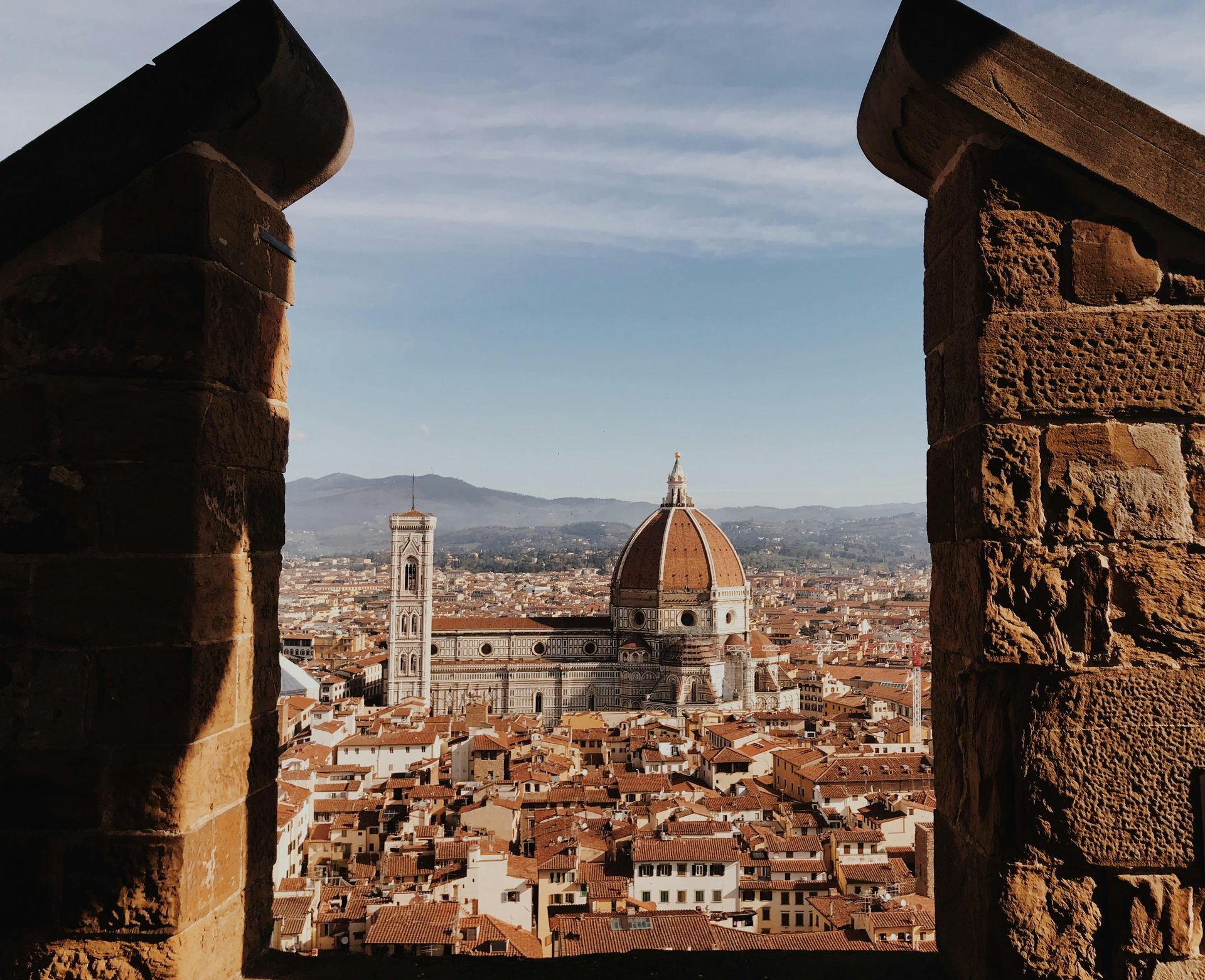
The most liquid market in Tuscany, where well-priced apartments in good condition sell within 60 to 90 days. Oltrarno and Santo Spirito run 5,000 to 7,500 EUR/m², with strong rental demand. Santa Croce and Sant’Ambrogio sit at 4,500 to 6,500, close to the university. The Duomo and Piazza della Signoria are prestige locations at 6,000 to 9,000. San Frediano and Isolotto, just outside the restricted-traffic zone, run 3,500 to 5,000. Across the centre, the working range for a properly restored apartment is 4,500 to 7,000 EUR/m² by condition and floor. The official property observatory (OMI) captures cadastral transactions and is a useful floor, not a ceiling; restored apartments in prime buildings frequently transact above its reference bands. For villas and the hillside villages above the city, see Florence and Fiesole property.
Lucca
A walled city of 90,000 with a working year-round community of schools, hospital, markets, and theatre. Inside the walls, apartments run 2,800 to 4,200 EUR/m², with a restored Piano Nobile reaching 4,500. Outside the walls, 1,800 to 2,500. The gap to Florence for comparable quality is substantial, and for a buyer who intends to live there rather than visit, Lucca is the stronger choice. For the surrounding hills and the wider region, see Lucca and Garfagnana.
Siena
Smaller and more contained than Florence. The centro storico runs 2,500 to 3,800 EUR/m², with units near Piazza del Campo at the top and the university quarter around Porta Romana at 2,200 to 3,000. The city goes quieter from October through March, which bears on rental occupancy, but central values have held steady.
Arezzo and Cortona
Arezzo’s centre sits at 1,500 to 2,500 EUR/m², reflecting lighter international demand. Cortona runs 2,000 to 3,200, with limited inventory and a premium on Valdichiana views.
Heritage rules: what you can and cannot change
Every apartment in a Tuscan centro storico sits in Zone A of the urban plan, where the historic fabric is protected. External change needs heritage-authority approval: window sizes, facade colours, visible air-conditioning units, and roof solar on a street-facing slope all fall under this. Internal work is easier but not free of process. Moving a non-structural wall requires a filing; structural change needs an engineer’s certification; merging or splitting units needs a full building permit and heritage review. Approval timelines run 60 to 120 days. If the building itself carries a formal listing (vincolo), every interior intervention goes through the heritage authority, and the state holds a pre-emption right on sale, adding a notification step to the transaction, though it is rarely exercised on residential apartments.
The energy certificate (APE) is required at every sale. Most apartments in historic centres carry Class F or G. A full upgrade to Class A is rarely achievable in a listed building because the facade cannot be touched; Class C or D is realistic after replacing windows, heating, and insulation where permitted.
Condominio and running costs
Italian condominium law governs every building with two or more units. Standard monthly charges (spese condominiali) run 150 to 400 euros and cover insurance, cleaning, the lift, common lighting, and the administrator. Before reaching the preliminary contract, three documents matter: the last three years of meeting minutes, which reveal disputes and planned works; the maintenance fund balance, since a facade restoration can mean a one-off levy of 10,000 to 30,000 euros per unit; and the millesimi table, which fixes your cost share and voting weight.
One detail catches buyers: under Italian condominium law the buyer inherits solidary liability for the seller’s unpaid charges for the current and the prior year. Older debts can also transfer if they are not disclosed explicitly. Requesting a full debt certificate (stato dei pagamenti) from the administrator before the preliminary contract is signed removes that uncertainty. In my mandates I ask for this before the offer stage.
For a second-home purchase, total transaction costs run roughly 9 to 10 per cent of the price: transfer tax on the (typically lower) cadastral value at 9 per cent, notary fees, agent commission at 4 per cent plus VAT, and the technical survey. Annual costs add the second-home property tax (IMU) at 0.46 to 1.14 per cent of the cadastral value, the waste tax (TARI), and the condominium charges above.
Where does buying to let still work?
Florence and the other Tuscan cities now diverge on short-term rental. Florence stopped issuing new licences in the UNESCO core from January 2024. Existing licences are transferable and carry a market value of their own; a buyer who acquires a property with a valid, transferable licence can continue operating it. A property without one is restricted to long-term letting inside the UNESCO zone. Long-term letting yields less but carries no licence risk and no registration complexity.
Lucca, Siena, Arezzo, and Cortona have no comparable ban. Short-term letting stays open with national registration (CIN, mandatory since 2025) and the flat rental tax (Cedolare Secca): 21 per cent on a first let property and 26 per cent on further ones, which for most non-resident owners is more favourable than the progressive income-tax bands. From the third property onwards, the activity is treated as a commercial undertaking under the 2026 reform. Yield depends on the specific apartment, nightly rate, occupancy, purchase price, and management; a credible projection needs real numbers for the unit in question.
For where these cities sit in the broader region, see where to buy in Tuscany and the 2026 market overview. For recurring errors across all property types, including deposit risk and conformità, see 7 mistakes foreign buyers make in Italy.
Frequently asked questions
Can I buy a city apartment in Italy as a non-EU citizen?
Yes. Italy places no purchase restriction on foreign buyers. You need an Italian tax number (codice fiscale) and an Italian bank account, both arranged before completion. Non-EU nationals from countries with a reciprocity arrangement qualify; the US, UK, Canada, and Australia all do. The process runs from accepted offer to preliminary contract (compromesso) to notarial deed, typically three to six months. A listed building can take longer because of the state’s pre-emption notification period.
Is buying for rental income realistic?
It depends on the city and the licence situation. In Lucca, Siena, Arezzo, and Cortona, yes, with national registration and the flat tax; the return comes down to nightly rate, occupancy, purchase price, and running costs. In Florence’s UNESCO core, new short-term licences are no longer issued. A property with an existing transferable licence can continue to let short-term; without one, long-term letting is the practical route, which yields less but is stable. Any specific unit needs its own projection.
What ongoing costs should I expect?
Condominium charges of 150 to 400 euros a month, the second-home property tax (IMU) at 0.46 to 1.14 per cent of the cadastral value per year, and the waste tax (TARI) at 200 to 600 euros depending on size and municipality. Building insurance is usually inside the condominium charge. The larger, less predictable cost is the special assessment: a facade or roof restoration can mean 10,000 to 30,000 euros per unit, which is exactly why the meeting minutes and the maintenance fund matter before you buy.
Can I get a mortgage as a non-resident?
Italian banks typically lend 50 to 60 per cent of value to non-residents, at fixed rates around 3.5 to 4.5 per cent as of mid-2026, with pre-approval taking four to eight weeks. The lower loan-to-value ratio means a larger cash share than buyers from the US or UK often expect; it belongs in the budget from the outset. More in the financing guide.
Do I need a car, and can I park?
In the historic centres, mostly no. The restricted-traffic zone (ZTL) covers the cores of Florence, Lucca, and Siena, with camera-enforced fines; a second-home owner without Italian residency in the municipality cannot use the resident ZTL permit and relies on public garages or pre-arranged private parking. A private garage adds 30,000 to 80,000 euros in Florence and 15,000 to 40,000 in Lucca or Siena, and counts as a separate cadastral unit.
How long does the purchase take?
From accepted offer to notarial deed: typically 60 to 90 days. With a mortgage or a complex condominium situation, 90 to 120 days is more realistic. The full process is in the buying guide.
Is Siena or Florence the better choice?
Siena sits at 2,500 to 3,800 EUR/m², well below Florence, and is compact enough to cross on foot in 15 minutes. The city’s contrade structure creates dense neighbourhoods with real community life. The trade-off is connectivity: no international airport, and the railway station sits outside the centre. Florence is more expensive and more visited, but directly reachable by train and from Pisa and Florence airports. For buyers arriving mainly by car, Siena is the quieter option.
Andrej Avi advises buyers from across Europe on purchasing city apartments in Tuscany. Contact me · Current listings
Further reading: Buying process in Italy · Taxes on Italian property · Codice fiscale and bank account · Mortgage for non-residents · Villa in Tuscany · Casale in Tuscany
July 2026. General information, not legal or tax advice.