Florence is Italy’s second most expensive city after Milan, with an average of 4,500 to 4,700 EUR/m² and annual price growth of 7 to 8 per cent. Inside the historic walls the market divides sharply: an apartment in the centre, or a villa on the hills above it. Those are two different decisions with two different price logics, and most buyers who contact me arrive thinking only about the first.
The typical purchase in the old town is a 120 to 250 m² apartment on the main floor of a 15th to 18th-century palazzo. There is almost no new construction; the UNESCO protection and the historic walls cap supply permanently, so what trades is always existing stock. Buyers who want land, a garden, and a pool go eight kilometres up to Fiesole or a neighbouring hill, where the same budget buys space rather than a central address. For buyers comparing Florence with Lucca or Siena as a city base, the city apartment guide for Tuscany sets out the three markets side by side.
What does property in Florence cost in 2026?
The old town runs 5,300 to 6,200 EUR/m² for ordinary palazzo apartments and reaches 12,000 to 15,000 for trophy floors with frescoes, a terrace, or an Arno view. Fiesole sits at 4,000 to 8,000+ EUR/m², but you buy a villa, not a flat.
| Zone | EUR/m² | Segment |
|---|---|---|
| Old town (average) | 5,300-6,200 | Palazzo apartments |
| Old town (luxury: frescoes, terrace, Arno view) | 8,500-12,000 | Unique properties |
| Old town (top tier: penthouse, restored palazzi) | 12,000-15,000 | Trophy assets |
| Oltrarno / San Frediano | ~6,300 | Strong upward trend |
| Piazzale Michelangelo / Porta Romana | ~6,500 | Panoramic apartments |
| Santa Croce | ~5,500 | Strong upward trend |
| Bellosguardo / Arcetri | 5,000-9,000 | Panoramic villas |
| Fiesole | 4,000-8,000+ | Hilltop villas |
| Bagno a Ripoli | ~3,440 | Hillside, value end |
| City average | 4,500-4,700 | +7-8% YoY |
Italy’s official price observatory understates the top tier; its reported maximums run 30 to 50 per cent below what the best floors actually sell for. View and condition move the per-square-metre figure more than floor area does. Negotiation room in the centre is narrow, because well-priced apartments clear in four to eight weeks; on the hills and on older listings there is more give. How much depends on the property, its time on market, and its position, which I work through on a case-by-case basis. Buyer advisory service.
Fiesole and the hills: villas above Florence
Fiesole is the trade-off market: you live on the hillside and reach the Ponte Vecchio in twenty minutes. Prices run 4,000 to 8,000+ EUR/m², with villas from one to twelve million euros.. An 18th-century villa with 600 m² of living space, 1.5 hectares of parkland, and a view over the city runs four to six million; a simpler 250 m² house with a garden, 1.2 to 2 million. The spread is wide because Fiesole holds both frescoed historic villas and plain 1960s houses on the same hillside.
Fiesole has been the summer retreat of Florentine families for centuries, a pattern the Medici established when they built their villas here. That history sits in the architecture and in the surrounding gardens. The Etruscan museum, the Roman amphitheatre, and the Bandini collection give the town a cultural depth independent of Florence. Day-to-day infrastructure covers a primary school, restaurants, a supermarket, a pharmacy, and bus line 7 to Florence (around 25 minutes, last departure near half past midnight). Specialists and larger shops require a drive down.
For a hillside setting below Fiesole prices, Bagno a Ripoli (around 3,440 EUR/m², villas 940,000 to 3.2 million) is the closest alternative, twenty minutes south and quieter. Bellosguardo and Arcetri run 5,000 to 9,000 EUR/m², ten to fifteen minutes from the Duomo and a touch cheaper than Fiesole for comparable quality. Both have panoramic villas with views of the cathedral and old town.
One practical point: internet connectivity thins out from full fibre in the city to 30 to 80 Mbit on the hills, so coverage is worth checking at the exact address before you commit. The daily drive to the centre runs 25 to 35 minutes in normal conditions, more in the morning rush.
The neighbourhoods in the centre
The Oltrarno was the artisan quarter south of the Arno, and the workshops of shoemakers, framers, and restorers still shape its character. Over the past three years it has become the strongest buyer magnet in the city, trading around 6,300 EUR/m² and rising. There is less tourism here than around the cathedral, the Santo Spirito market sells food rather than souvenirs, and the Palazzo Pitti and Boboli gardens sit at the neighbourhood’s edge. Buyers who do not want to feel like visitors in their own home tend to look here first.
Santa Croce runs around 5,500 EUR/m² and rising for the same reason: long cheaper than the rest of the centre, now catching up as restoration and international interest drive prices upward. Piazzale Michelangelo and Porta Romana (around 6,500 EUR/m²) is where buyers land when they want a panoramic apartment without moving to the hills. San Niccolò, directly below Piazzale Michelangelo, sits between Santa Croce and Porta Romana in price, quieter than the centre but livelier than Fiesole.
What drives the price up, what drives it down
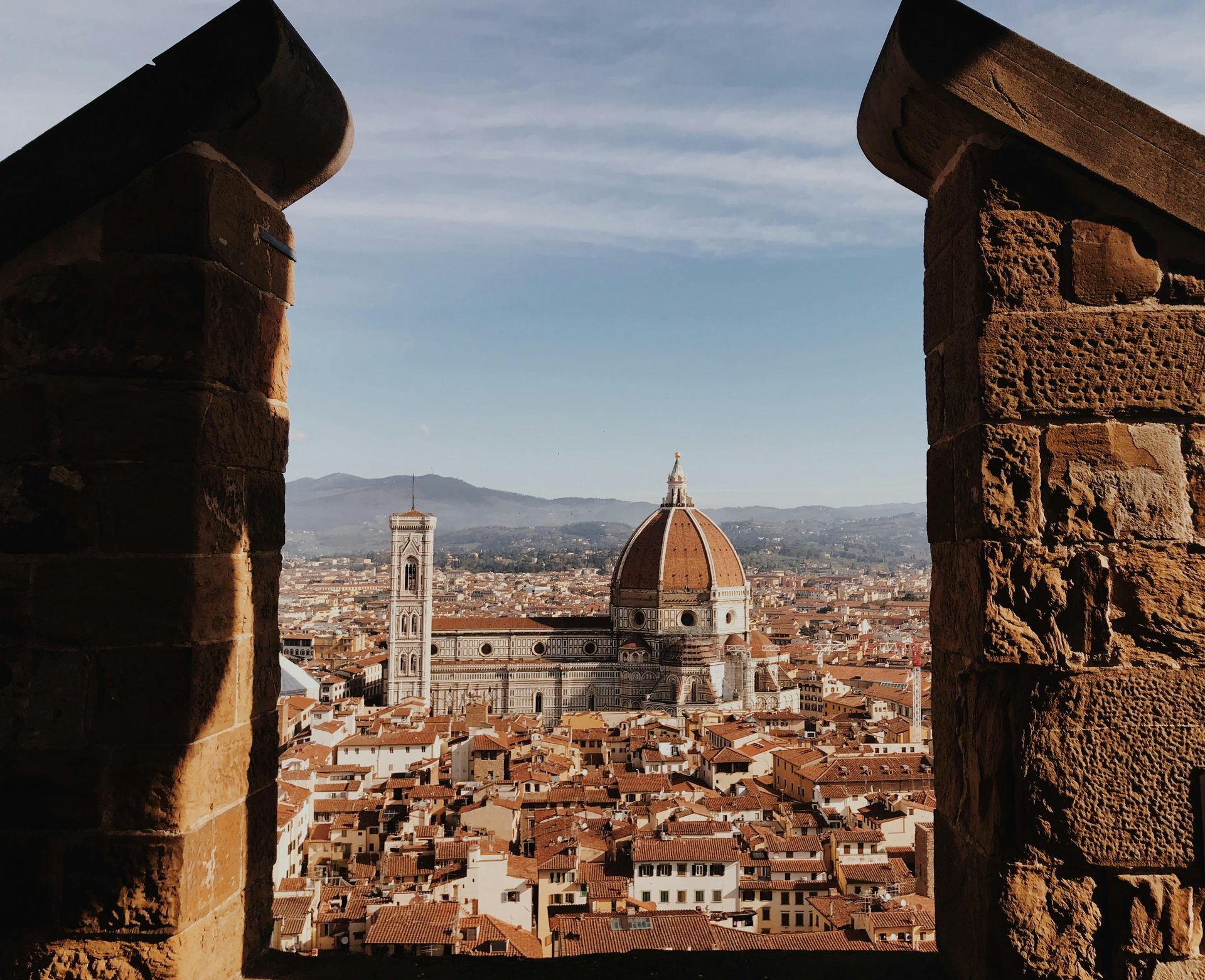
An Arno or Duomo view is a hard premium in Florence. In a city where most apartments face internal courtyards or side streets, an open view of water or cathedral is a measurable factor in the price.
A terrace or loggia is rare and valued accordingly. Old-town apartments typically have no outdoor space; a rooftop terrace of 30 to 50 m² is a distinct asset. Original fabric cannot be reproduced: frescoes, pietra serena floors, coffered ceilings. These elements raise the price and simultaneously restrict renovation options, because the heritage authority (Soprintendenza) must approve every intervention.
A lift adds 5 to 10 per cent to the rate, and a parking space in the centre is worth 30,000 to 80,000 euros on its own; most historic palazzi have neither. On the other side: ground-floor apartments without natural light sit 20 to 30 per cent below comparable units one floor up. Significant renovation under heritage protection depresses the price because the Soprintendenza does not approve modern windows, facade changes, or visible external air-conditioning units; restoration of a listed apartment runs 2,000 to 4,000 EUR/m², well above a standard renovation. Planned special assessments in the building are worth checking: a facade project of 200,000 euros spread across eight apartments means 25,000 per unit. The last three years of owners’ meeting minutes carry these entries and should be reviewed before any offer is made.
What buyers should know before they offer
In the old town you almost always buy into a shared building (condominio), with joint ownership of staircase, facade, roof, and sometimes a courtyard. Monthly charges (spese condominiali) run 150 to 500 euros depending on a lift, concierge, and building condition. Special assessments for facade or roof work can run 20,000 to 80,000 euros per apartment and are not always apparent on a viewing.
Florence is a UNESCO World Heritage site, so facade changes, window replacements, roof works, and exterior air-conditioning all require heritage approval. The entire old town is a limited-traffic zone (ZTL), closed to private cars except for residents with a permit costing around 120 euros a year; that permit allows entry but not street parking, which makes an enclosed parking space genuinely valuable. A surveyor’s check (geometra) before the preliminary contract is essential and costs 2,000 to 5,000 euros; it surfaces discrepancies between the official plans and the actual building before money is committed. Where a minor historical irregularity needs regularising, costs typically run 1,000 to 5,000 euros; larger issues 5,000 to 20,000 and above. More on the full purchase process.
| Type | Typical size | Price range | EUR/m² |
|---|---|---|---|
| Old town apartment | 80-250 m² | 500,000-3 million | 5,300-12,000 |
| Penthouse with terrace (Duomo view) | 150-300 m² | 2-6 million+ | 10,000-15,000 |
| Hillside villa (Fiesole / Bagno a Ripoli) | 300-800 m² | 1-12 million | 4,000-8,000+ |
| Historic villa (16th-18th c.) | 500-1,500 m² | 3-12 million+ | 5,000-10,000 |
Rental income and the new letting rules
Short-term letting has reshaped who buys in Florence. The city sits third on Italy’s visitor rankings after Rome and Venice, with year-round demand from art, conferences, and universities, and more buyers now factor rental income into the purchase even when they intend to use the place themselves.
Italian law now requires a national registration code (CIN) for every short-term rental; without it, a property cannot be listed on booking platforms. The municipality holds the power to restrict short-term lets in specific old-town zones for set periods; no zone restriction was in force as of mid-2026, but the legal basis exists. A rental-driven purchase should be underwritten on a conservative number of lettable days, not the headline figure. The hill villas in Fiesole face fewer regulatory constraints than old-town apartments but draw a smaller rental audience. The full picture on CIN registration and what tightening looks like in practice is in the short-term rental regulation guide for Tuscany.
On purchase tax: registration tax is 2 per cent of the cadastral value for a primary residence and 9 per cent for a second home, with notary fees of 3,000 to 8,000 euros and agent commission of 4 per cent plus VAT. Budget 12 to 15 per cent in transaction costs on top of the purchase price for a second home.
Connectivity, daily life, and when to buy
Florence Amerigo Vespucci airport (FLR) is fifteen minutes from the old town by taxi or car, with direct flights to London, Paris, Munich, Zurich, Frankfurt, and other European cities. For intercontinental routes, Pisa airport (PSA) is around one hour by car, or you connect via Rome Fiumicino, roughly 2.5 hours door to door using the high-speed train from Santa Maria Novella. That train station puts Rome 90 minutes away, Bologna 37, and Milan under two hours, which makes Florence practical for buyers who move between Italian cities for work.
| Destination | From old town | From Fiesole | Transport |
|---|---|---|---|
| Florence airport (FLR) | 15-20 | 20-25 | Car / taxi |
| Pisa airport (PSA) | 60-75 | 70-85 | Car / train + bus |
| Bologna | ~37 | - | High-speed train |
| Rome (Termini) | ~90 | - | High-speed train |
| Milan (Centrale) | ~100 | - | High-speed train |
| Siena | 75-90 | 85-100 | Car / coach |
| Chianti (Greve) | 40 | 50 | Car |
| Careggi hospital | 15 | 20 | Car |
For everyday life, the old town offers the Mercato Centrale (San Lorenzo), the less touristy Mercato di Sant’Ambrogio, and supermarkets in the wider centre. Fiesole residents shop at a local co-operative and go to the Esselunga on Via Masaccio (fifteen minutes) for larger runs. Culturally, Florence is in a league of its own in Tuscany: the Uffizi, Palazzo Pitti, Bargello, Accademia, Museo dell’Opera del Duomo, and dozens of smaller museums and theatres. The Maggio Musicale Fiorentino, one of Europe’s oldest music festivals (since 1933), runs in spring. For buyers with children of school age, Florence has four international schools (International School of Florence, American School, Canadian Island, Scuola Internazionale) and several universities with English-language programmes including the European University Institute in Fiesole, NYU Florence, and Syracuse. No other town in Tuscany matches this.
Careggi hospital (a university hospital with all specialities) is fifteen minutes from the centre and twenty from Fiesole. The summer heat is heavier in the city than on the hills: the old town reaches 32 to 38 degrees in July and August, while Fiesole runs 2 to 3 degrees cooler, which is precisely why the Medici built their summer villas on the hillside.
Florence runs differently from the rural Tuscan markets: there is no winter slowdown. The city stays inhabited and lively year-round, so viewings happen in January as readily as in June. March to May brings most new listings to market, as sellers time their launch to coincide with spring tourism and the return of international residents. From June to August, many buyers rent for a week or two and view alongside; August is quieter because owners and agents travel, but competition eases accordingly. September and October form a second active wave as universities reopen and temperatures settle.
November to February has less activity but the most negotiating room. A winter viewing is worth doing even if the first visit was in spring: the heating is tested, natural light in the apartment appears in its worst case, and the city shows itself without tourist density. A purchase agreed in December often completes at the notary in spring, once the surveyor’s report and any regularisation are resolved.
FAQ: buying property in Florence and Fiesole
What does an apartment in the Florentine old town cost?
On average 5,300 to 6,200 EUR/m², so a 120 m² apartment runs 640,000 to 750,000 euros. An Arno view or a rooftop terrace pushes that to one or two million, and penthouses with a Duomo view start at two million. View, outdoor space, and original fabric move the price far more than floor area, which is why two apartments of the same size on the same street can sit a million apart.
Is Fiesole cheaper than the old town?
Not necessarily. Per-square-metre prices in Fiesole run 4,000 to 8,000+, against 5,300 to 6,200 in the centre, so the rate can look similar. The difference is what you get: in Fiesole the money buys a 300 to 800 m² villa with a garden, in the centre an 80 to 250 m² apartment. Total budgets in Fiesole often run higher, and the practical exchange is a daily drive into the city.
What purchase costs should I budget for?
Registration tax of 9 per cent on the cadastral value for a second home (2 per cent for a primary residence), notary fees of 3,000 to 8,000 euros, agent commission of 4 per cent plus VAT, and a surveyor’s check at 2,000 to 5,000 euros. For a second home, the total transaction costs come to roughly 12 to 15 per cent on top of the purchase price. More detail in the Italy purchase guide.
Do I need a car in Florence?
In the old town, no. The limited-traffic zone keeps private cars out, and the city is walkable or accessible by bus. In Fiesole and on the hills, yes: without a car you depend on bus line 7, which runs every 20 to 30 minutes with a last departure around half past midnight. It is one of the clear practical lines between the two markets.
Is Florence a good place to buy for rental income?
Demand is strong and year-round, with a clear upward trend since 2019. The achievable yield depends on the property and can only be judged after a careful property-specific calculation. The open question is regulation: Italian law lets the municipality cap short-term lets in chosen zones, and national registration (CIN) is mandatory. A sensible yield case rests on a conservative number of lettable days rather than the headline figure.
City or hills: how do I choose?
The city suits buyers who want cultural infrastructure in daily life (restaurants, museums, theatre, cinema) and easy access to the airport and rail. The hills suit buyers who want a garden, a pool, and quiet, and accept a drive for them. A central apartment with an Arno view and a hillside villa with parkland often cost the same and represent two different ways of living in Florence. I usually suggest spending time in both before committing. See current properties · Where to buy across Tuscany.
What is the purchase process in Italy for a foreign buyer?
The Italian process has three stages: the offer (proposta di acquisto), the preliminary contract (compromesso), and completion at the notary (rogito). The offer binds both sides once accepted, which differs from the process in the UK or the United States where commitment comes later. A deposit of around 10 per cent is paid at the preliminary contract stage; if the seller withdraws, the buyer receives double that amount back. The total time from offer to completion typically runs three to six months. A surveyor checks the building before the preliminary contract, and a lawyer can review the purchase terms. More on the purchase process.
Andrej Avi is an estate agent in Tuscany. Buying guidance · Properties · About Andrej
As of July 2026. General information, not legal or tax advice.