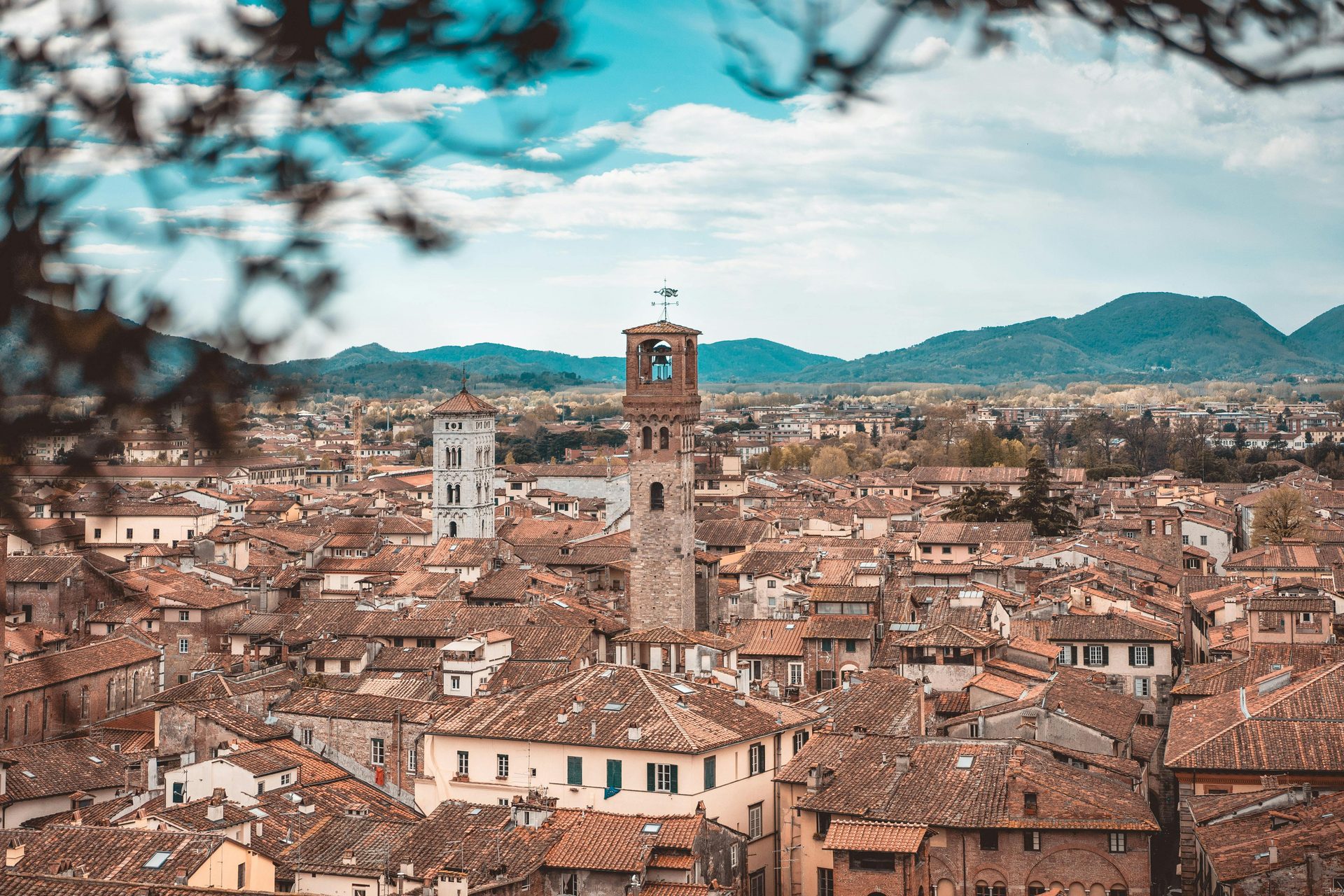
Lucca is the only Tuscan city with a fully intact Renaissance city wall: a closed 16th-century ring wide enough for a row of trees and a cycling path on top. Within it: 90,000 residents, restaurants and specialists reachable on foot, Pisa airport 30 minutes away. Fifteen minutes out, the Colline Lucchesi begin, where historic villas have stood for centuries. Forty minutes further north, the Garfagnana opens, a mountain valley between the Apuan Alps and the Apennines, with medieval villages, rivers, chestnut forests, and prices well below the city. One province holds two markets that run by entirely different rules.
What does property cost in Lucca and the Garfagnana?
Inside the Centro Storico, prices start at 3,600 EUR/m² and the wall caps supply, so the trend is up. In the Garfagnana, a village house sits below 1,200 EUR/m², sometimes below 800. Between them lie the Colline Lucchesi, where historic villas and stone Casali define the upper segment.
| Zone | EUR/m² | Segment |
|---|---|---|
| Centro Storico (within the walls) | 3,575-3,659 | Rising |
| Centro Storico (renovated, prime) | up to 4,100 | Rare stock |
| Lucca city average | ~2,300 | Rising |
| Lucca periphery | ~1,500 | Functional, limited appeal |
| Colline Lucchesi (historic villas) | 2,000-4,500 | Historic substance |
| Colline Lucchesi (contemporary) | 3,500-4,000 | New build / full renovation |
| Barga | ~1,186 | Garfagnana, British community |
| Bagni di Lucca | ~1,000-1,300 | Thermal town |
| Castelnuovo di Garfagnana | ~900-1,200 | Valley centre |
The contrast is considerable. In the Centro Storico you pay from 3,600 EUR/m² upward. In the Garfagnana a village house sits below 1,200 EUR/m². Prices across the Lucca area have risen markedly over the past five years, driven by constrained supply inside the walls against steady demand. The per-square-metre figure falls with distance from the city and rises with position and condition.
From recent completed transactions: the range runs from a Villa Storica with parkland and Limonaia on the Colline Lucchesi, to a renovated apartment inside the walls, to a partly restored stone house in the Garfagnana. The market is genuinely stratified.
Why Lucca instead of Florence or Chianti?
Lucca delivers comparable historic quality at a lower price than Florence. In the luxury segment, the average sale per property runs 1.65 million euros in Lucca against 2.25 million in Florence. Inside the historic centres, Lucca runs around 3,600 EUR/m² while Florence runs 5,300 to 6,200 for comparable substance. That is a real difference.
Against the Chianti, Lucca’s advantage is its urban infrastructure. In Chianti you need a car for the supermarket, the doctor, and dinner; in Lucca you walk, and the countryside is still fifteen minutes away. Lucca also avoids Florence’s overtourism: the city gets visitors, but stays a place where people live year-round. Pisa airport is 30 minutes out, with direct flights across Europe, including London, Paris and Munich.
The areas: Lucca, Colline Lucchesi, Garfagnana
Lucca Centro Storico (within the walls, roughly 15,000 residents) is a car-free historic centre with 99 churches, the elliptical Piazza dell’Anfiteatro (built on the outline of a Roman amphitheatre), and the birthplace of Giacomo Puccini. Apartments sit in historic palazzi, often with vaulted ceilings, terracotta floors, and interior courtyards. Typical sizes run 80 to 200 m² at 300,000 to 800,000 euros. Everything is within walking distance: restaurants, supermarkets, banks, doctors. Stock above 150 m² moves quickly. The main practical point: there is no private parking within the walls. Monthly spaces in the municipal car parks outside the gates cost around 50 to 80 euros.
The Colline Lucchesi (the hill parishes around Lucca, including Capannori, Montecarlo, Altopascio, and Villa Basilica) hold the upper segment of the Lucca market. The hills are known for their Ville Storiche: 16th- to 18th-century villas with a Limonaia (the lemon house that is the architectural signature of this area), a formal Italian garden, frescoes, private chapels, and olive groves. These villas exist in this concentration only in the Lucchesia. Running costs sit at 15,000 to 40,000 euros a year, covering the garden, historic fabric, and structural maintenance. Alongside the historic villas, the hills carry traditional stone Casali at 250 to 500 m² and 600,000 to 2 million euros. The Colline produce DOP Lucca olive oil, one of the most regarded in Italy; a productive grove is a value factor in its own right.
Barga (around 10,000 residents, Garfagnana) is a particular case. The town has a lively centre, views across the Apuan Alps, and a long-established British community: much of the population has Scottish roots, the result of 19th-century emigration and later return. There is an annual Scottish festival and an active community of international residents, which keeps the local market stable even as prices have drifted slightly lower. For buyers with a renovation budget, Barga is an entry point: village houses from 80,000 euros.
Bagni di Lucca (about 6,000 residents) was one of Europe’s most fashionable spa towns in the 19th century. Shelley, Byron, and Heine lived here. The thermal baths still function. The town has a quietly faded grandeur, prices between 1,000 and 1,300 EUR/m², and reasonable infrastructure for its size: supermarket, doctor, pharmacy, restaurants.
Castelnuovo di Garfagnana (around 5,800 residents) is the administrative centre of the Garfagnana. The fortress was governed by Ariosto, the Renaissance poet. The town has a hospital, schools, a weekly market, and everything needed for daily life. Prices sit at 900 to 1,200 EUR/m². Around Castelnuovo, smaller villages offer stone houses for under 100,000 euros. The valley produces Farro della Garfagnana IGP, a protected-origin spelt, and has its own distinct cuisine: more chestnut, wild boar, and mountain herbs than the Tuscan mainstream.
Lunigiana (the border territory between Tuscany and Liguria, north of the Garfagnana) is a market in motion. Demand is rising noticeably and prices remain below the Garfagnana. Buyers who want early entry into a market that is being discovered should look here.
Distances
| From | Pisa airport (PSA) | Florence centre | Florence airport (FLR) | Motorway | Hospital |
|---|---|---|---|---|---|
| Lucca Centro | 30 | 80 | 85 | 10 (A11) | 10 (San Luca, LU) |
| Colline Lucchesi | 35-45 | 75-90 | 80-95 | 15-25 | 15-25 (San Luca) |
| Barga | 65 | 100 | 105 | 40 | 25 (Castelnuovo) |
| Bagni di Lucca | 55 | 95 | 100 | 30 | 20 (Castelnuovo) |
| Castelnuovo | 75 | 110 | 115 | 50 | 5 (Castelnuovo) |
For buyers driving from northern Europe: the A11 (Firenze-Mare) and A12 give Lucca good motorway access. Pisa airport serves as the primary hub for the area; Florence airport is the alternative for onward connections. The Frecciarossa serves Florence from Bologna and Rome; from Florence a regional train reaches Lucca in around 90 minutes. Lucca’s station sits directly outside the city walls, which makes day trips to Florence practical.
In the Garfagnana, a car is essential. Mountain roads are winding and occasionally restricted by snow in winter.
Property types
| Type | Typical size | Price range | EUR/m² |
|---|---|---|---|
| Villa Storica (Colline Lucchesi) | 500-1,500 m², Limonaia, park, frescoes | 1-5 million | 2,000-4,500 |
| Casale (hills around Lucca) | 250-500 m² | 600k-2 million | 2,500-4,000 |
| Apartment, Centro Storico | 80-200 m², within the walls | 300k-800k | 3,000-4,100 |
| Podere with land | 200-400 m², 2-10 ha | 400k-1.5 million | 2,000-3,500 |
| Village house, Garfagnana | 100-250 m² | 80k-250k | 800-1,200 |
The Villa Storica with its Limonaia is the defining property of the Lucchesia. That architectural combination of lemon house, formal Italian garden and olive grove exists in this density nowhere else in Tuscany. The villas date from the 16th to 18th century, often with original frescoes, private chapels, and formal gardens that require upkeep and specialist contractors. Buying one means taking on a listed monument, with annual running costs between 15,000 and 40,000 euros.
Apartments inside the walls sit in historic palazzi with vaulted ceilings, original terracotta floors, sometimes a small courtyard or roof terrace. The market is tight: limited stock, consistent demand. Anything above 150 m² moves quickly.
The hill Casali resemble their Chianti counterparts in build quality but carry olive groves rather than vineyards. A productive grove of DOP Lucca oil has measurable value on its own. Renovated Casali with a pool run at 2,500 to 4,000 EUR/m², noticeably below a comparable Chianti Casale at 3,500 to 5,500, for similar construction quality.
The Garfagnana village house is the opposite proposition: natural stone, thick walls, typically empty, needing a full renovation covering roof, electrics, plumbing, and heating at around 1,200 to 2,000 EUR/m². With many houses available for under 100,000 euros, the total of purchase plus renovation often approaches the eventual market value. The buyers who are satisfied with a Garfagnana purchase are those who viewed in both summer and winter before committing, and who ran the numbers before making an offer. Buyer advisory.
What drives the price up, what brings it down
Factors that push the price noticeably higher:
- Historic fabric. Frescoes, original floors, a Limonaia, a formal garden. A contemporary villa on the Colline runs 3,500 to 4,000 EUR/m²; a Villa Storica with original features can reach 4,500, for older construction, because the market pays for the irreplaceable detail.
- Views toward Lucca. Many Colline villas have sightlines to the towers of the city. The view cannot be reproduced and is priced accordingly.
- A productive DOP olive grove. DOP Lucca oil carries market value, and a working grove adds both income and identity.
Factors that reduce the price:
- Energy class F or G. Stone facades without insulation, old heating systems. A class G house in the Garfagnana costs 4,000 to 7,000 euros a year to heat. Buyers already factor the remediation cost into their offers.
- Access and position. Some Garfagnana properties reach only via single-track mountain roads that become difficult in winter. In Lucca, properties without private parking trade below those with a garage.
- Demographic contraction (Garfagnana). Castelnuovo holds steady; smaller villages lose residents. Fewer people mean fewer shops, doctors, and schools. This is a fact to price into the decision, not an alarm.
When to view, when to buy
February to April sees new stock come to market. The olive groves are coming into leaf, and the landscape shows its quality without summer heat. A useful time for first viewings.
May through July is the peak season for viewings. The Lucca Summer Festival brings international concerts to the Piazza Napoleone in June and July, and many buyers combine a festival visit with property appointments. Days are long, properties show well.
August is quiet for transactions: sellers on holiday, the notary’s office harder to reach. Buyers planning for the Garfagnana will get a sense of village life from the local sagre, the seasonal village festivals.
September and October are the months before the olive harvest on the Colline: warm light, comfortable temperatures, and the strongest emotional case for the property. November brings the harvest itself; a viewing timed alongside a visit to the local frantoio (oil press) gives a clear picture of what the place is actually like.
November through February carries a larger stock of available properties because fewer buyers are active. For the Garfagnana, this window has a particular use: a viewing in winter shows the house without a flattering summer filter. The heating is tested, the road is checked in rain, the condition of the windows and walls becomes visible. At least one winter visit is worth building into the process.
Regulations and the purchase process
On the Colline Lucchesi, many villas carry a heritage listing. Any change to the facade, windows, roof, or garden requires approval from the Soprintendenza, Italy’s heritage authority, a process of three to eight months. Rooftop solar panels are almost always refused; ground-level installations in the garden are sometimes approved.
Building conformity needs to be established before the preliminary contract. In the Garfagnana, where houses have been altered across generations without permits, discrepancies between the plans and the actual building are common. A surveyor’s review costs 2,000 to 5,000 euros; retroactive approval where needed runs from around 1,000 to 5,000 for minor irregularities, and 5,000 to 20,000 euros and above for more substantial works. This can be established before any commitment is made. The same regulation that slows a renovation also holds the value: no new warehouse rises next to the villa, the view stays protected, and the declining supply of habitable properties against steady demand supports prices structurally. More detail in the Italy buying guide.
The purchase itself moves through three stages: the offer (proposta), the preliminary contract (compromesso), and completion before the notary. The proposta binds both parties on acceptance, well before completion, which differs from the solicitor-led process in the UK. The notary checks the ownership chain, encumbrances, and the land registry entries, but does not verify that what was built matches the permits: that is the surveyor’s role. More in the due diligence guide.
Lucca vs. Chianti: a direct comparison
| Criterion | Lucca / Colline Lucchesi | Chianti Classico |
|---|---|---|
| Renovated Casale (EUR/m²) | 2,500-4,000 | 3,500-5,500 |
| Unrenovated Casale (EUR/m²) | 1,500-2,500 | 1,000-2,000 |
| Urban infrastructure | Lucca, 90,000 residents, all on foot | Greve (13,800) is the largest town, limited |
| Nearest airport | Pisa, 30 min. | Florence, 45-70 min. |
| International buyers | Less dominant, broader spread | Very international, price-defining |
| Wine | DOC Colline Lucchesi (modest) | Chianti Classico DOCG (prominent) |
| Olive oil | DOP Lucca (highly regarded) | Present, not DOP-protected |
| Budget alternative nearby | Garfagnana (from 80,000 euros) | None comparable |
| Year-round livability | Lucca: fully year-round | Limited (thin infrastructure, seasonal) |
Chianti carries the stronger name. Lucca has the better infrastructure and lower prices. For buyers who want a Casale as a second home and value wine country and quiet, Chianti remains the first choice. For buyers who plan to live in Tuscany year-round, or who want a city within walking distance, Lucca is the more practical answer. The Garfagnana has no equivalent in Chianti: a mountain stone house under 150,000 euros simply does not exist in those hills.
The Garfagnana as its own market
The Garfagnana is not a luxury market and is unlikely to become one. The valley’s character is specific: the Apuan Alps as the backdrop, mountain terrain rather than soft hills, little tourism, village communities that still function. The river Serchio runs through the valley; walking trails reach into chestnut forests and to medieval bridges.
The prices reflect the demographics. A modest village house in the Garfagnana trades at the price of a mid-range car. The reason is structural: communities are shrinking, younger residents move to the cities, and the infrastructure thins accordingly. Castelnuovo holds; smaller villages lose. That is worth knowing before any purchase.
For whom does the Garfagnana work? For buyers with a renovation budget and a preference for mountain quiet. For buyers who own a car and do not need restaurants within walking distance. For couples or families who want a retreat rather than a status address. Barga is the most active entry point: its British community has sustained demand across decades, and the town has enough life to function year-round.
Lucca and the Garfagnana sit 40 minutes apart and work by entirely different rules. Get in touch and we can work out which zone fits your use.
Frequently asked questions
What does a villa on the Colline Lucchesi cost?
Historic villas with a Limonaia and parkland run 1 to 5 million euros at 500 to 1,500 m² of living space, which is 2,000 to 4,500 EUR/m² depending on substance and condition. Stone Casali on the hills run at 600,000 to 2 million. As a reference point, a villa of 680 m² with parkland sold for 2.4 million euros, or 3,530 EUR/m². The figure rises with original frescoes, views toward Lucca’s towers, and a productive olive grove, all of which the market prices accordingly.
Is Lucca cheaper than Florence?
Yes. In the luxury segment the average sale per property runs 1.65 million euros in Lucca against 2.25 million in Florence. Inside the historic centres, Lucca sits around 3,600 EUR/m² while Florence runs 5,300 to 6,200 for comparable substance. The gap is structural: both have risen, but Lucca’s less internationalised buyer base has kept prices below Florence even as the market has strengthened.
Is Lucca cheaper than Chianti?
Yes. Renovated Casali on the Colline run at 2,500 to 4,000 EUR/m² against 3,500 to 5,500 in Chianti Classico. On a 400 m² Casale, that is a difference of 400,000 to 600,000 euros. The Garfagnana (from 800 EUR/m²) has no equivalent in Chianti at all.
Is buying in the Garfagnana worthwhile?
For a buyer with a renovation budget and comfort with rural remoteness: yes. Village houses start at 80,000 euros, and the valley offers mountain landscape and intact communities with little tourism. The practical reality: shrinking communities, thinning infrastructure, and a thin margin where purchase plus renovation often approaches the eventual market value. This is a project and a retreat, not a second home with a restaurant around the corner. Barga is the exception, kept active year-round by its established British community.
Are there heritage restrictions on the villas?
Yes. Historic villas on the Colline Lucchesi carry a heritage listing, so the facade, windows, roof, and garden layout all require approval from the Soprintendenza: a process of three to eight months. Interior work is less restricted, but maintaining the historic fabric, the garden, and any frescoes remains demanding. The restriction works in both directions: it slows renovation and it protects the setting long term.
Can I live in Lucca year-round?
Yes, and that separates Lucca from most Tuscan markets. A city of 90,000 provides a hospital (the Ospedale San Luca, modern, with a full A&E department), specialists, supermarkets, schools, cultural events, and train connections, all on foot within the walls. Most Tuscan locations function primarily as second-home markets because daily infrastructure is thin. The Garfagnana is more seasonal, but Barga and Castelnuovo function year-round for buyers at ease with smaller-town life and a working level of Italian.
What does renovating a Garfagnana village house cost?
Roughly 1,200 to 2,000 EUR/m² depending on the condition of the roof, electrics, plumbing, and heating. On a 150 m² stone house that is 180,000 to 300,000 euros on top of the purchase price. Because many properties are available for under 100,000 euros, the combined budget for purchase and renovation often sits close to the eventual market value. A buyer here is usually buying to live in the house, and it is worth modelling the full cost before any offer. For costs, timelines, and the permit process: renovating in Tuscany.
How far is Lucca from the airport?
Pisa (PSA): 30 minutes, with direct flights from London, Paris, Amsterdam, Vienna, Zurich, Frankfurt and Berlin. Florence (FLR): 80 minutes. For buyers based in Lucca, Pisa is the working airport. That is a clear advantage over Chianti, where the nearest airport is 45 to 70 minutes away.
Andrej Avi is an estate agent in Tuscany, advising buyers from across Europe from first inquiry to completion at the notary. Buyer advisory · Properties · About Andrej · Buying property in Italy: the guide
As of July 2026. General information, not legal or tax advice.