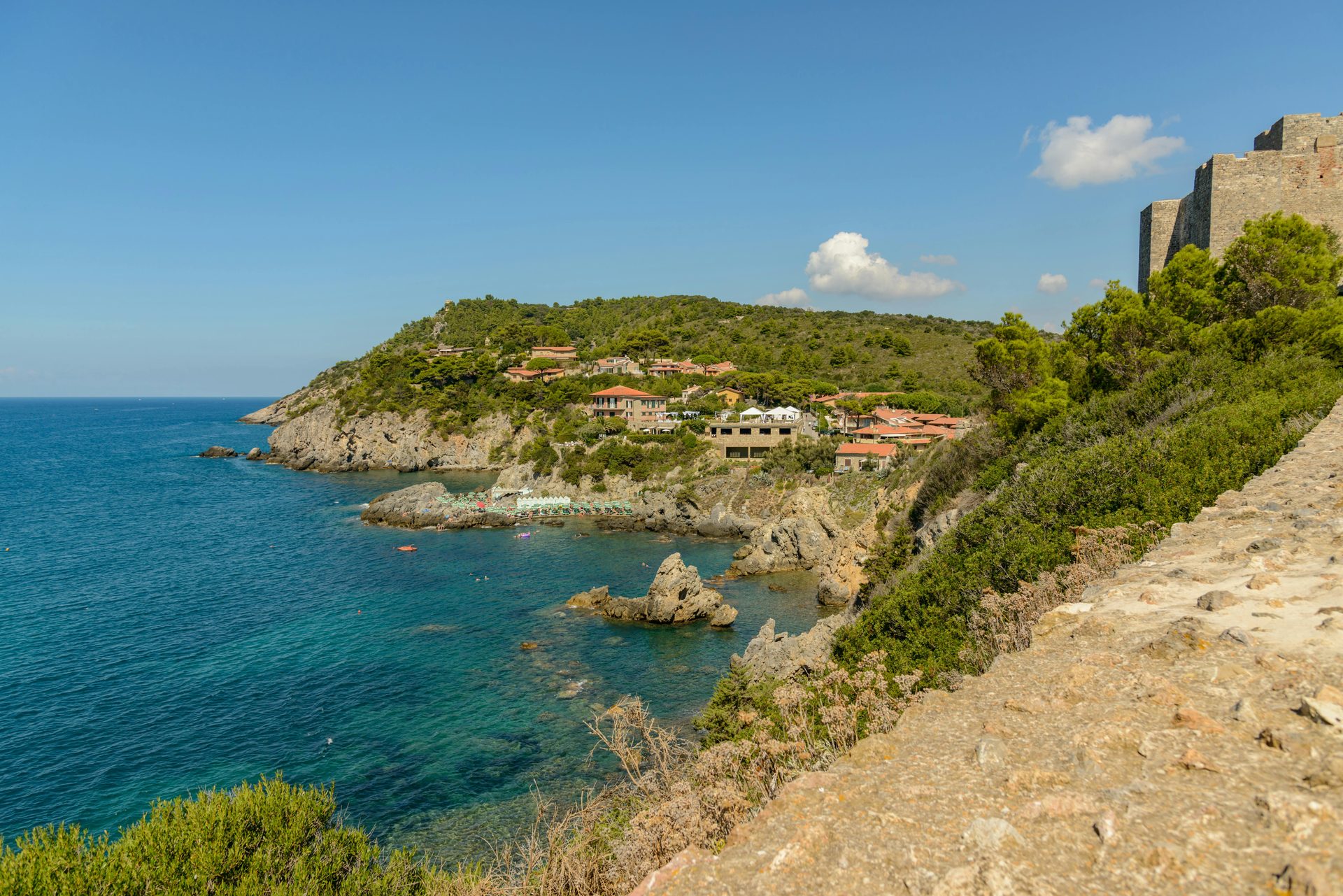
In Roma Imperiale, the prime quarter of Forte dei Marmi, a villa behind the beach trades at 14,000 to 22,000 EUR/m², and the best plots reach 40,000. Fifteen minutes inland, in the Camaiore hills, a stone house with a garden sells for 2,000 to 4,000. Same coastline, same province, a fraction of the price. The line between them is whether you can walk to the sea.
The Versilia is a 20-kilometre coastal strip in the Province of Lucca between the Apuan Alps and the Tyrrhenian Sea, split among four municipalities: Forte dei Marmi, Pietrasanta, Camaiore (including Lido di Camaiore), and Viareggio. There are no farmhouses, no vineyards, no olive terraces on a hillside. The stock is villas behind walls and apartments near the beach. The market is predominantly Italian, dominated by wealthy families from Milan and Rome who use their property 8 to 12 weeks a year. The estimated property stock across the zone is valued at around 3.47 billion euros, placing it third in Italy among coastal markets. Buyers looking for the Tuscan countryside find a different country altogether here: coastal, dense, seasonal, and in a different price bracket from the Chianti.
What property costs across the zone
Forte dei Marmi sets the ceiling, averaging 10,065 to 11,500 EUR/m², with the Roma Imperiale quarter running at 14,000 to 22,000 and prime plots behind the beach reaching 40,000. The remainder of the zone trades well below that, which is where most international buyers actually transact.
| Location | Renovated EUR/m² | Needs work EUR/m² | Typical total |
|---|---|---|---|
| Forte dei Marmi: Roma Imperiale (prime) | 22,000-40,000 | 8,000-12,000 | 4-15 million |
| Forte dei Marmi: Roma Imperiale (standard) | 14,000-22,000 | 8,000-12,000 | 3-8 million |
| Forte dei Marmi: Centro / Pineta | 10,000-14,000 | 6,000-9,000 | 1.5-5 million |
| Pietrasanta | 2,900-8,600 | 1,500-3,400 | 500k-3 million |
| Viareggio (seafront) | 4,500-6,500 | 2,500-4,000 | 400k-2 million |
| Lido di Camaiore | 4,000-5,500 | 2,500-3,500 | 400k-1.5 million |
| Camaiore hinterland | 2,000-4,000 | 1,000-2,000 | 200k-800k |
| Massarosa | 1,500-3,000 | 800-1,500 | 150k-600k |
Pietrasanta is where buyers go who want the Versilia without the Forte price. A villa that costs 3 to 5 million in Forte trades at 1.5 to 2.5 million in Pietrasanta, with the difference available for renovation. The town has a year-round centre, galleries, and a marble-carving tradition that has drawn international sculptors since the 1960s: Fernando Botero, Igor Mitoraj, and Kan Yasuda have all had workshops here. Viareggio is a working city of 62,000 with a hospital, a main-line station with connections to Florence and Pisa, and Art Nouveau seafront apartments rather than villas. Lido di Camaiore is the family beach section, with apartments from around 500,000 euros. Below 800,000, the Camaiore hinterland is the only realistic entry into the Versilia.
The municipalities, access, and what buyers find there
Forte dei Marmi (7,400 inhabitants) is compact: the beach, a town centre with boutiques and restaurants, and the villa quarters Roma Imperiale and Vittoria Apuana behind it. The infrastructure runs for the summer and winds down sharply. Many restaurants, bars, and shops close from November to March. There is no secondary school, no hospital, no year-round commercial fabric; the Wednesday market is one of the most visited in Tuscany. Buyers who plan to live in Forte full-time need to see the town in January before they commit.
Pietrasanta (24,000 inhabitants) functions across the full year. Galleries, cafés, bookshops, and restaurants stay open in winter. The coastal section, Marina di Pietrasanta, is five minutes by car from the historic centre. For buyers who want cultural depth alongside the coast, Pietrasanta is the strongest option in the zone.
Viareggio (62,000 inhabitants) is the largest and most urban municipality: hospital, schools, a main-line station, supermarkets, and a full commercial centre all year. The Carnival of Viareggio (since 1873) is the second largest in Italy after Venice. The property stock is mostly apartments; detached villas appear at the city edges and towards Torre del Lago.
Camaiore (33,000 inhabitants) covers Lido di Camaiore and an extensive hinterland rising into the Garfagnana hills. The town centre has a weekly market, supermarkets, and schools. For buyers with a budget under one million, Camaiore is the entry point to the Versilia. Massarosa (23,000 inhabitants), in the hinterland between Viareggio and the Lago di Massaciuccoli, carries the lowest prices in the area (1,500 to 3,000 EUR/m²) and a quiet character shaped by the lake. Puccini composed at Torre del Lago on the lake’s edge; the open-air Puccini Festival takes place there each summer.
On access: Pisa airport is 25 to 35 minutes from the Versilia, with direct flights from London, Frankfurt, Vienna, Zurich, and Berlin. A Friday evening departure can land on a Forte terrace the same night, which is a different proposition from the 90 to 120 minutes between a Tuscan airport and the Chianti. Viareggio has intercity rail; Forte dei Marmi has a regional station at Querceta in the neighbouring municipality of Seravezza.
| From | Pisa airport | Florence | Milan | Hospital Versilia | Main-line station |
|---|---|---|---|---|---|
| Forte dei Marmi | 35 | 100 | 180 | 20 | 20 (Viareggio) |
| Pietrasanta | 30 | 95 | 175 | 15 | 15 (Viareggio) |
| Viareggio | 25 | 90 | 180 | 5 | 0 (own station) |
| Lido di Camaiore | 25 | 95 | 180 | 10 | 10 (Viareggio) |
| Camaiore hinterland | 35 | 90 | 185 | 15 | 20 (Viareggio) |
Property types
The Versilia has no farmhouse market: no casali, no agricultural conversions. The stock is villas and apartments.
| Type | Typical size | Price range | Character |
|---|---|---|---|
| Liberty villa | 300-600 m² | 2-6 million | 1920s-1940s, large gardens, architectural detail |
| Modern villa | 200-500 m² | 3-8 million+ | Built or fully refurbished last decade, pool, flat roof, smart systems |
| Pineta villa | 250-500 m² | 2-5 million | Set in pine woodland, quieter, behind Roma Imperiale |
| Seafront apartment | 80-200 m² | 500k-2 million | Walking distance to the beach, seasonal use |
| Palazzo apartment | 100-250 m² | 800k-3 million | Historic buildings, mainly Viareggio and Pietrasanta |
| Hinterland house | 150-400 m² | 300k-1.2 million | Stone, garden, rural, 15 minutes to the beach |
The Liberty villa is the signature property type of the zone: 300 to 600 m², large gardens, architectural detail from the 1920s and 1940s. Renovation work is almost always needed on electrics, heating, and roofing. Many of these buildings carry heritage listing, which means the heritage authority (Soprintendenza) has a say in any external change. A full renovation costs 1,800 to 3,000 EUR/m², above the hinterland rate, because of salt-air corrosion and more expensive local trades. How a renovation in Tuscany actually runs, which permits it requires, and what it realistically costs belong in the analysis before any offer.
The modern villa is what has been built or completely refurbished in the past ten years: flat roofs, large glazed openings, pools, and integrated building controls. In Roma Imperiale, these properties trade at 8 to 15 million. The Pineta villa sits in the pine belt behind Roma Imperiale: the character is attractive, though pines cast shade and drip resin onto terraces and cars. For international buyers with a budget below two million euros, the realistic options in the Versilia are a seafront apartment in Lido di Camaiore or Viareggio, a palazzo apartment in Pietrasanta, or a house in the Camaiore hinterland.
What moves the price
Distance to the sea is the dominant value driver, above condition and above size. Under 500 metres to the beach pulls a premium. The Roma Imperiale address functions as a brand: the same villa 800 metres further north, outside the quarter, sells for meaningfully less. The hardest price boundary in the zone is the A12 motorway, which divides the Versilia into sea side and mountain side. Two villas with identical floor plans, one each side, carry a substantial gap. Railway noise from the Pisa-Genoa line, which runs parallel to the coast, affects prices on the streets it crosses. The absence of a sea view in an expensive position is a legitimate point of discussion before any offer, provided the asking price has not already accounted for it.
One feature that surprises almost every British or American buyer: the beach in the Versilia is private. The shore is divided into concession strips (stabilimenti), beach clubs with sun loungers, a bar, and usually a restaurant. A seasonal membership in Forte dei Marmi runs 10,000 to 30,000 euros and functions as a social marker as much as a service; buying in Forte without a membership is noticed. In Viareggio and Lido di Camaiore the equivalent costs 2,000 to 6,000 euros, and the public beach sections are wider. Direct beach access from a private plot barely exists in the Versilia; most villas sit 200 to 800 metres back from the water, separated by roads and pine. The beach-club structure is one of several surprises common among buyers new to Italy that are worth knowing before you fall for a property.
Regulation, renovation, and running costs
The entire coastal strip sits under landscape protection (vincolo paesaggistico). Any change to a building’s exterior requires sign-off from the heritage authority: facade colours, roof materials, extensions, pergolas, each taking three to six months to process. Rooftop solar panels are generally refused near the beach; ground-level installations in a garden are sometimes approved, more readily in the hinterland.
Liberty-era villas frequently carry individual heritage listing (vincolo Belle Arti) on top of the general protection. That means every window and every facade element needs a separate permit. A buyer who plans an open-plan interior needs to know whether the listing covers internal structure before signing the preliminary contract (compromesso). These checks belong with your own surveyor and lawyer. The notary confirms ownership, checks the title chain back twenty years or more, and registers the sale; verifying that the building as constructed matches its permits is a separate exercise done beforehand. The regulation that creates this complexity is also what holds the value: pine rows stay between the villas, sightlines to the water do not change, and no neighbour can build upward.
Running a Versilia property as an absentee owner is a real cost. A 300 m² villa needs a caretaker, pool service, garden maintenance, and seasonal checks, totalling 8,000 to 20,000 euros a year depending on plot size. Air conditioning is standard here and adds to summer bills. These costs belong in the budget before any offer is made.
Seasonal patterns and everyday life
The Versilia runs on two speeds. From June to September the market is active: most viewings, most offers, most completions. The municipality triples its population in July and August. From October to March, activity drops sharply, many properties come off the market, and sellers who did not close over the summer become more flexible in autumn. The buyer who wants to negotiate has a better position in the off-season than at the height of summer, when several parties may be bidding simultaneously. April and May are the pre-season window: fresh listings arrive, photographs are taken in spring light, viewings increase. For a purchase timed for summer, spring is the shortlisting period.
One winter visit before committing is not optional in the Versilia. Forte dei Marmi in January, with shuttered restaurants and empty streets, is a genuinely different place from August. A buyer who only knows the summer version is working on half the information.
Day to day: Viareggio has supermarkets, a shopping centre, and a full commercial offer year-round. Forte has a small supermarket and the Wednesday market; a number of food shops and restaurants close from November to March. Pietrasanta and Camaiore have supermarkets and weekly markets throughout the year. The coastal cuisine is seafood-driven: fish restaurants, and the cacciucco fish stew from Viareggio. A straightforward fish restaurant runs 40 to 60 euros per person; the upper end in Forte sits at 80 to 150. The hinterland around Camaiore carries the standard Tuscan menu at lower prices.
The coast is warmer and more humid than the Chianti in summer (28 to 34°C) and milder in winter (5 to 12°C). A 300 m² villa will spend 2,000 to 4,000 euros on cooling in summer and 3,000 to 6,000 on heating in winter. Fibre broadband in Forte, Pietrasanta, and Viareggio is reliable at 100 Mbit and above. In the Camaiore and Massarosa hinterland, expect 20 to 50 Mbit; checking the specific address before committing takes minutes and matters if you work remotely.
English is spoken in hotels and restaurants in Forte; at council offices, among tradespeople, and at medical appointments, rarely. The Ospedale Versilia in Lido di Camaiore covers the whole zone (15 to 20 minutes from Forte), with specialist care in Pisa (30 minutes) or Florence (90 minutes). There is no international school in the Versilia; the nearest is the International School of Florence, roughly 90 minutes away, which is a material factor for families planning full-time residence.
Versilia or Chianti
These two markets share a regional name and almost nothing else.
| Factor | Versilia | Chianti Classico |
|---|---|---|
| Property type | Villas, apartments | Casali, villas, estates |
| Character | Coastal, urban, dense | Rural, vineyards, quiet |
| Price EUR/m² | 4,000-40,000 | 1,000-5,500 |
| Seasonality | Pronounced | Moderate |
| Core buyers | Italians (Milan, Rome) | International buyers |
| Year-round use | Possible but limited in Forte | Yes |
| Infrastructure | Full (Viareggio), seasonal (Forte) | Limited (rural) |
| Airport | Pisa: 25-35 min | Florence: 25-70 min |
The question that settles the choice is how the property will actually be used. Four to twelve weeks in summer points to the coast. Twenty weeks or year-round points to the Chianti or the hinterland. I cover both regions; the first question I ask any buyer is that one. See available properties.
For the broader regional picture, see where to buy in Tuscany and the Tuscany market overview for 2026.
Frequently asked questions
What does a villa in Roma Imperiale cost?
Standard villas in Roma Imperiale run 14,000 to 22,000 EUR/m². At 300 m², that is roughly 4.2 to 6.6 million euros. Prime properties on large plots directly behind the beach reach 40,000 EUR/m², placing them at 8 to 15 million. The Roma Imperiale address carries its own premium: the same house a few streets north, outside the quarter, sells for meaningfully less. Below that level, the realistic Forte entry is Centro or Pineta at 10,000 to 14,000 EUR/m².
When is the best time to buy in the Versilia?
October to March. The summer market runs hot, with several buyers bidding on the same property and sellers under little pressure. From autumn, sellers who did not close during the season are more prepared to move on price. I also recommend at least one winter visit: Forte in January is a different place from August, and a buyer who only knows the summer version is working on incomplete information. View in autumn, decide before the next season starts.
Is Pietrasanta a real alternative to Forte dei Marmi?
Yes, and it is the strongest alternative in the zone. Pietrasanta runs 2,900 to 8,600 EUR/m² renovated, against 10,000-plus in Forte. It has a year-round town centre, an active gallery and sculpture scene, restaurants open in winter, and a five-minute drive to Marina di Pietrasanta for the beach. Buyers who want Versilia life without the Forte premium tend to land here.
What is a stabilimento and do I need one?
A stabilimento is a private beach club occupying a concession strip of the shore, with sun loungers, umbrellas, a bar, and usually a restaurant. In Forte dei Marmi a seasonal membership runs 10,000 to 30,000 euros and is as much a social signal as a practical facility. Buying in Forte without a membership is noticed. In Viareggio and Lido di Camaiore, the equivalent costs 2,000 to 6,000 euros, and there are wider public beach sections.
What rental income can I expect in summer?
A villa in Roma Imperiale commands high weekly rates in July and August; the figure depends on the property. The constraint is the window: the worthwhile season is only a few weeks, and from October to May most rental stock sits unused. The flat tax on short-let income (Cedolare secca, 21 per cent for the first property, 26 per cent from the second) is generally more favourable than progressive income tax. Whether a property earns its keep comes down to those peak weeks, the location, and the running costs. More on the structure in the guide to rental income in Tuscany.
Can foreign buyers purchase in the Versilia?
Yes, without restriction. EU citizens buy freely. US, UK, Canadian, and Australian nationals purchase under a reciprocity arrangement that works smoothly in practice. You need an Italian tax number (codice fiscale) and an Italian bank account, both straightforward to obtain before the purchase. From accepted offer to completion at the notary, the process runs three to six months. The full sequence, including the offer stage (proposta), the preliminary contract (compromesso), and the deposit mechanics, is in the Italy buying guide.
Andrej Avi is an estate agent in Tuscany specialising in the Versilia and the wider Tuscan coast. Buying guidance · Properties · About Andrej
Further reading: Tuscany property by the sea · Maremma property
As of July 2026. General information, not legal or tax advice.