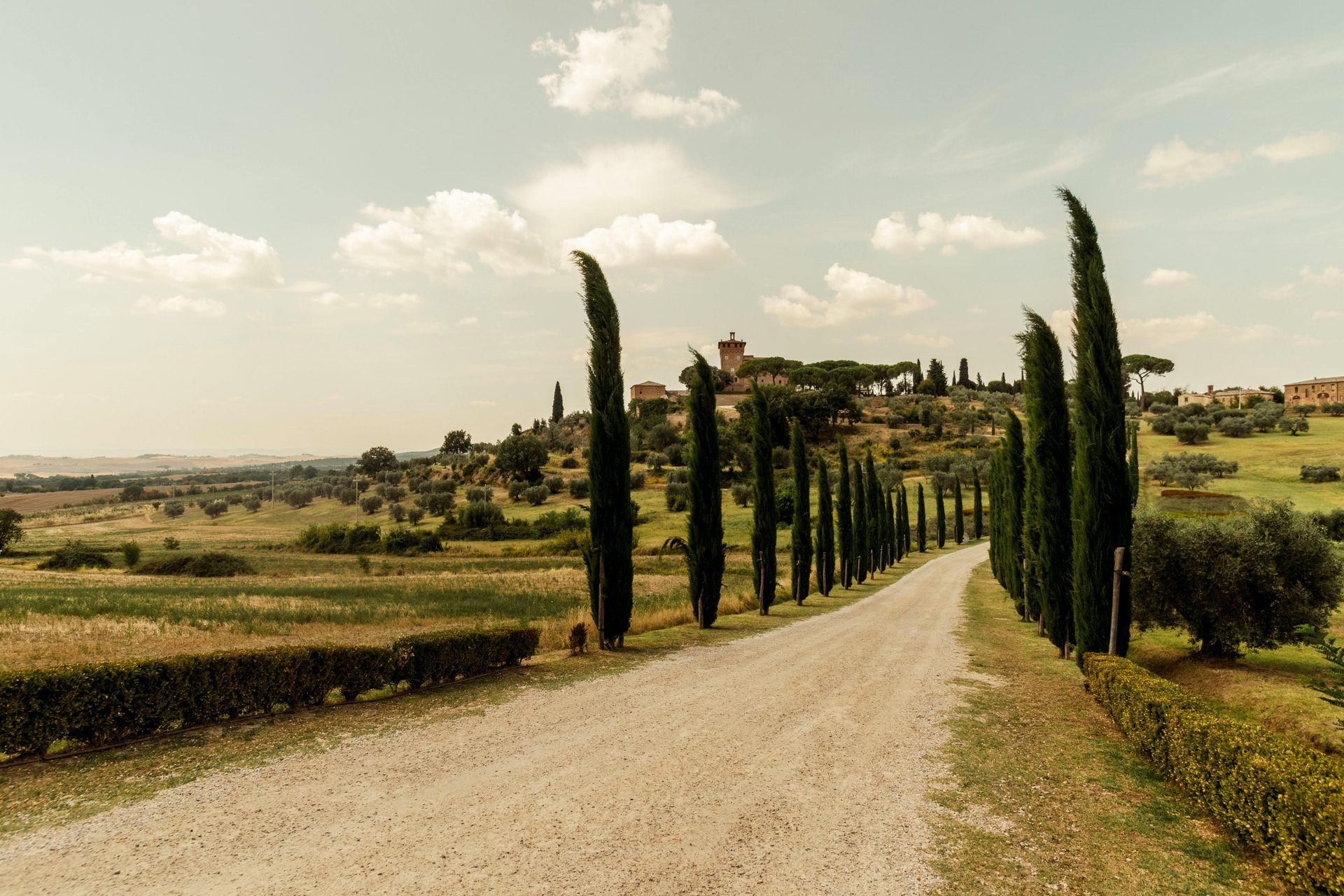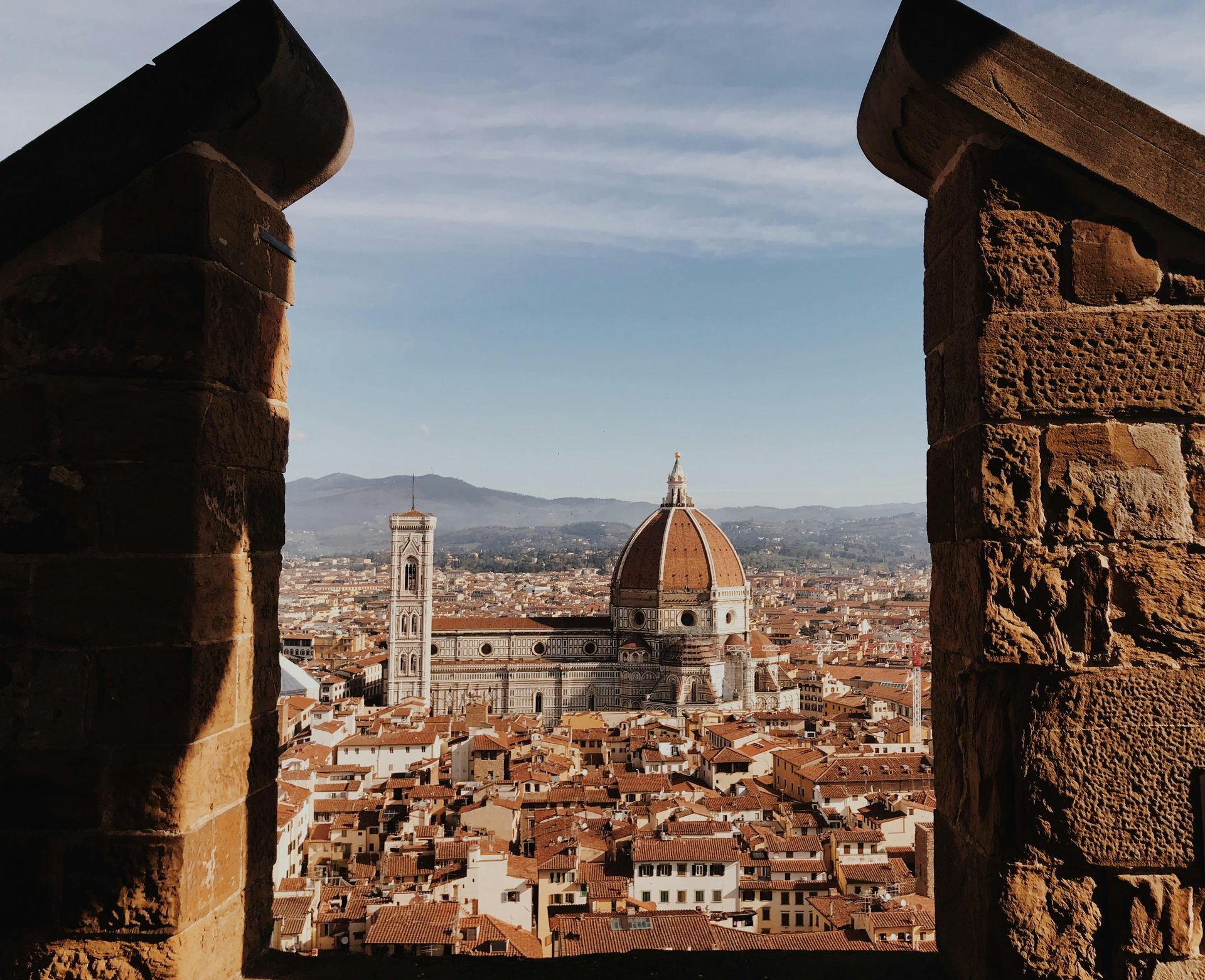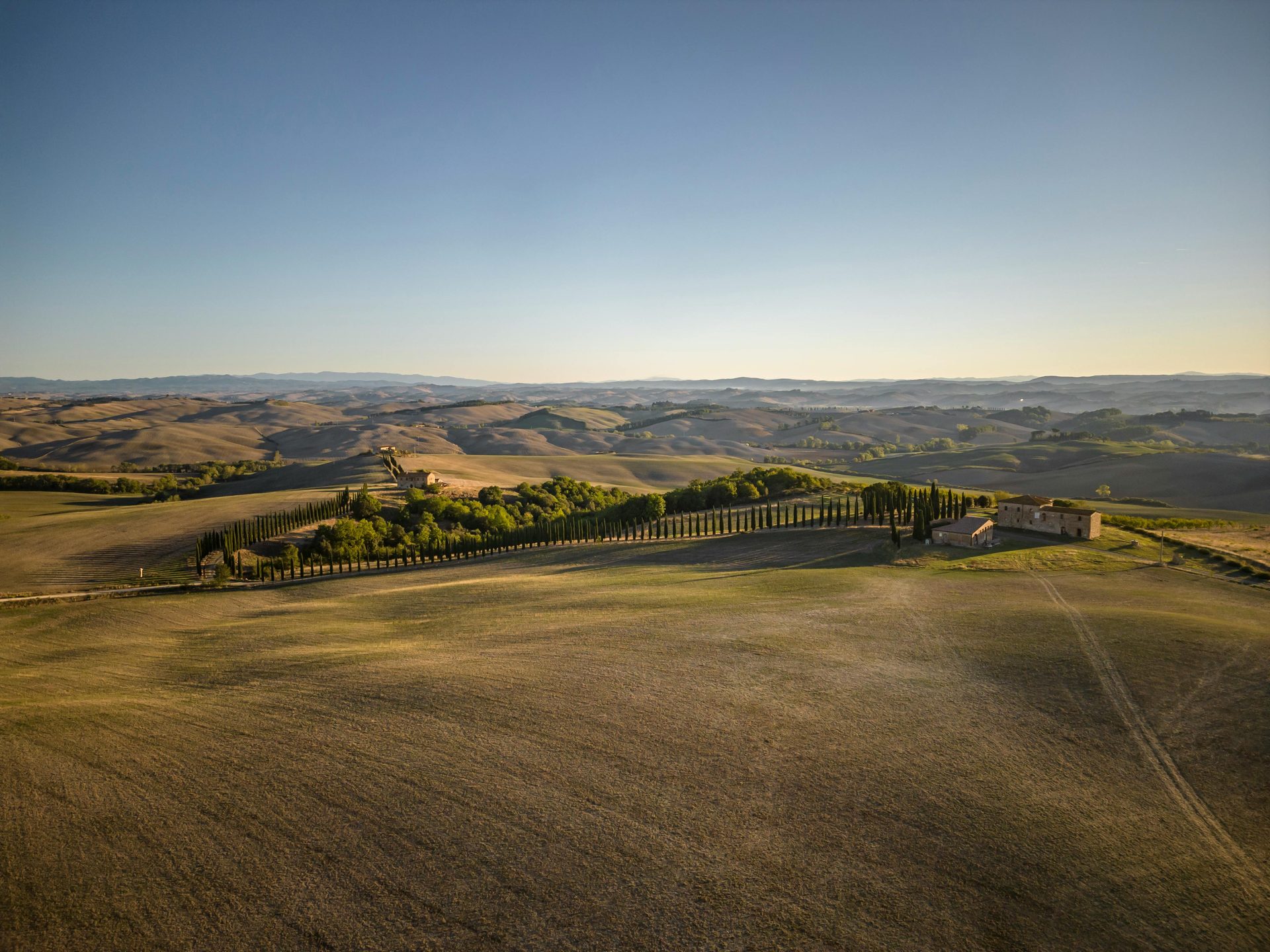
This corridor between Chianti and the Maremma delivers the same Tuscan landscape at noticeably lower prices, and few international buyers have it on their radar. San Gimignano, with its fourteen medieval towers and UNESCO World Heritage status since 1990, anchors the expensive end; Volterra, thirty kilometres to the southwest with 2,500 years of continuous history, anchors the affordable one. Competition from other international buyers is thinner, the stone country house stock is comparable in quality, and the regulatory protection that keeps new development out is as strong here as anywhere in Tuscany.
The two towns attract different buyers. San Gimignano draws investors and agriturismo planners, because over three million day visitors a year and the Vernaccia wine designation give a guest business a clear commercial logic. Volterra attracts buyers who put quality of substance above a famous address and expect more house per euro. Both are close enough to view in a single trip.
What does property cost in San Gimignano and Volterra?
San Gimignano’s old town runs 3,000 to 5,000 EUR/m², its countryside 2,000 to 3,500. Volterra averages 1,500 to 3,000. The whole zone sits between pricier Chianti to the east and cheaper Maremma to the south.
| Municipality | EUR/m² | Trend | Notes |
|---|---|---|---|
| San Gimignano (old town) | 3,000-5,000 | Rising | UNESCO premium; villas ~2,550 |
| San Gimignano (countryside) | 2,000-3,500 | Rising | Casali with tower views at the top end |
| Volterra (general) | 1,500-3,000 | Stable | Priced below San Gimignano |
| Volterra (casali) | 2,775-2,930 | Stable | Range 1,830-3,830 |
| Colle di Val d'Elsa | 1,850-2,100 | Rising | Service town, entry-level prices |
| Certaldo | 1,370-2,003 | Stable | Casali 1,370; town centre 2,003 |
| Poggibonsi | ~1,200-1,500 | n/a | Lowest price level in the zone |
| Monteriggioni | ~2,480 | Correcting | Price correction after post-Covid inflation |
The spread runs from Poggibonsi at roughly 1,200 EUR/m² to San Gimignano’s old town at 5,000. One pattern is specific to San Gimignano: the per-square-metre price drops sharply with distance from the centre, so a country house three kilometres out with a clear view of the towers costs well under an apartment inside the walls. In Volterra that gradient is flatter, because the centre carries no comparable brand premium. Italy’s official property price observatory reports maximums of around 2,550 EUR/m² for villas in San Gimignano; the best properties trade above that, since the official scale does not capture tower views, the UNESCO perimeter, or Vernaccia vineyard land.
There is room to negotiate, and how much depends on the specific property, its time on market, and timing. In Monteriggioni currently more, after the recent price correction. In winter, more than in summer. I work through the specific case with each buyer before any approach is made. Buying advisory.
What the UNESCO status means for buyers
San Gimignano has carried UNESCO World Heritage status since 1990, and it cuts both ways for buyers. It carries a measurable premium over Volterra or Certaldo for comparable building substance; the name alone lifts the price. It also locks in protection: no new construction in the historic core, nothing built into the sightlines of the towers, a skyline that stays as it is, which supports value over the long term. The cost of that protection is approval time. The heritage authority reviews every exterior change, and inside the UNESCO perimeter the process runs four to eight months rather than the standard three to six.
Tourism is the other side of the equation. Over three million day visitors a year move through the lanes, and on a summer afternoon the historic centre is effectively an open-air museum. For a permanent resident that is a real constraint; for an agriturismo three to five kilometres outside it is the engine, because the property captures the visitor stream without sitting inside it.
Volterra: a distinct market in the same corridor
Volterra averages 1,500 to 3,000 EUR/m² against San Gimignano’s 2,000 to 5,000, with country houses running 2,775 to 2,930 in a spread from 1,830 to 3,830. An informed buyer finds stronger substance for less money here than in San Gimignano. The town has an intact medieval and Etruscan core, a living alabaster craft tradition, and the international recognition that came with film tourism, without the day-tripper density of its neighbour.
One practical difference: Volterra belongs to the Province of Pisa, not Siena, which means a different land registry, a different building authority, and a different official price zone. Geographically nothing changes. With 10,000 residents it carries better year-round infrastructure than San Gimignano (7,800, seasonal): doctors, pharmacies, supermarkets, schools, and its own hospital. For anyone planning to be on site for months at a time, that gap matters more than the headline price.
International demand shapes prices in San Gimignano more strongly than in Volterra, where fewer overseas buyers compete. San Gimignano also draws buyers with an agriturismo plan: the visitor numbers, the UNESCO name, and Vernaccia wine make a guest business commercially viable. Volterra draws a different type: buyers who want quality over address recognition and are willing to accept less brand value in exchange for more building and land per pound or euro.
Property types and what moves the price
| Type | Typical size | Price range | EUR/m² |
|---|---|---|---|
| Casale (renovated, pool) | 250-500 m² | 800,000-2.5 million | 2,500-4,500 |
| Casale (unrenovated) | 300-600 m² | 250,000-700,000 | 800-1,500 |
| Villa with panoramic views | 400-800 m² | 1.5-4 million | 2,800-5,000 |
| Old town apartment | 80-200 m² | 200,000-600,000 | 2,500-5,000 |
| Podere with Vernaccia vineyard | 150-300 m², 1-3 ha | 500,000-1.5 million | 2,000-3,500 |
| Tenuta / wine estate | 500+ m², 10-160 ha | 2-17.5 million | Blended calculation |
The country house (casale) is the dominant type: a former stone farmhouse of two or three storeys with outbuildings and land. A renovated casale with a pool is the most sought-after category among UK and international buyers. An unrenovated one costs a third to half as much, but adds twelve to twenty-four months of work and an architect who knows the heritage approvals process. The gap between the two is wider here than in Chianti, because fewer buyers are active and unrenovated houses sit on the market longer.
A particular product in this zone is the podere with a Vernaccia vineyard. Vernaccia di San Gimignano is Tuscany’s only white DOCG appellation. Two hectares of vines, a main house, and outbuildings start at around 800,000 euros. With a full wine estate (tenuta) the price comes from hectares, harvest volume, and appellation; the buyer is acquiring a business.
Three factors push a price up here: a clear view of the towers of San Gimignano (no other Tuscan zone has that skyline), a productive vineyard or olive grove, and an existing permitted pool, since approval inside the UNESCO zone runs four to eight months. Against that, access only by unpaved track is a stronger negotiating point here than in Chianti, because demand is thinner. Energy class F or G covers most of the older stock, and the premium for well-renovated houses is rising as standards tighten. Cadastral discrepancies between official plans and the actual building affect nearly every older house; the nature and scale of any such discrepancy is what a pre-offer survey by a licensed local surveyor establishes. The survey costs 2,000 to 5,000 euros and is the step that brings the full picture before any commitment is made.
Buyers comparing this zone with its neighbours should also look at Maremma property to the south and Val d’Orcia property to the east. More on the purchase process.
Distances and getting there
San Gimignano is fifty minutes from central Florence and thirty from Siena; the Poggibonsi expressway exit is fifteen minutes away. Volterra is more remote, at seventy-five minutes from Florence and thirty-five from the nearest motorway junction. Florence airport (Amerigo Vespucci) has direct flights from across Europe, including London, Paris, and Munich; Pisa (Galileo Galilei) is larger and covers more routes. Florence airport is similar in distance for both towns (fifty-five and eighty minutes respectively); Pisa has an advantage for Volterra at sixty minutes against eighty.
| From | Florence centre | Siena | FLR airport | PSA airport | Expressway | Hospital |
|---|---|---|---|---|---|---|
| San Gimignano | 50 | 30 | 55 | 70 | 15 (Poggibonsi) | 20 (Poggibonsi) / 30 (Le Scotte, SI) |
| Volterra | 75 | 50 | 80 | 60 | 35 (Colle VdE) | 15 (Volterra) / 50 (Le Scotte, SI) |
| Colle di Val d'Elsa | 45 | 20 | 50 | 75 | 5 (FI-SI) | 10 (Poggibonsi) |
| Certaldo | 40 | 35 | 45 | 80 | 10 (Poggibonsi) | 15 (Poggibonsi) |
| Poggibonsi | 40 | 25 | 45 | 75 | 5 (FI-SI) | 5 (Poggibonsi) |
| Monteriggioni | 30 | 20 | 35 | 80 | 5 (FI-SI) | 20 (Le Scotte, SI) |
Regional trains on the Florence-Siena line stop at Certaldo and Poggibonsi, fifteen to twenty minutes by car from San Gimignano. A car is essential for the zone; without one, the countryside and smaller villages are not usable.
Living here and when to come
Most buyers use a casale six to ten weeks a year. The house needs maintaining in the meantime: garden, pool, airing in winter, heating checks. A local caretaker runs 300 to 600 euros a month. Some buyers let the property during their absence, others do not; both work, but the choice shapes the tax position. Rental guide for Italy.
In San Gimignano, English is spoken in most tourist businesses. At the commune office, with tradesmen, and at the doctor it is much less certain. Volterra is less tourist-facing; English coverage is thinner. The nearest international school is in Florence, about fifty-five minutes from San Gimignano. Buyers who plan to be on site for months at a time typically learn Italian; those coming six to eight weeks a year need someone local who handles trades and commune paperwork.
On timing: spring (March to May) brings the most new listings and shows the towns at their real character before the visitor season. Autumn (September to October) is the best time to experience the zone, and viewings in October regularly lead to offers within weeks. San Gimignano’s summer is the one period to be cautious about: the visitor volume makes old town viewings difficult and gives a misleading picture of ordinary life. Winter (November to February) brings less competition, fewer new listings, and wider room to negotiate. At least one winter visit is worth arranging even if the first viewing was in spring; the heating, access track in rain, and insulation of a stone house all read differently in December than in July.
Regulatory framework: landscape protection and what it means in practice
The entire zone sits under landscape protection (vincolo paesaggistico). Every change to an exterior surface requires approval from the heritage authority: window proportions, facade colours, roofing materials, extensions, pergolas, solar panels. The process runs three to six months in the standard case, four to eight inside San Gimignano’s UNESCO layer. In the UNESCO zone, solar panels on rooftops are typically refused. Ground-mounted arrays in the garden are more often approved in Volterra and the other municipalities.
Where agricultural land is involved, neighbouring farmers and the state agricultural authority hold a pre-emption right. On tenute with vineyard or olive grove this extends the purchase timeline by thirty to sixty days, because those entitled must be formally notified. This is a standard part of the process, but it belongs in the timeline from the outset.
The three-stage purchase structure, from offer (proposta) through preliminary contract (compromesso) to completion at the notary (rogito), and what to establish at each stage, is covered in the Italy purchase guide.
FAQ: buying property in San Gimignano and Volterra
What does a casale near San Gimignano cost?
Renovated, 800,000 to 2.5 million euros for 250 to 500 m²; unrenovated, 250,000 to 700,000 for 300 to 600 m², before a renovation that runs twelve to twenty-four months. Inside the old town, apartments trade at 3,000 to 5,000 EUR/m². The UNESCO name adds a real premium over comparable properties in Volterra or Certaldo, and a clear sightline to the towers adds more; two outwardly similar casali can sit far apart on price if one has the view and the other does not.
Is Volterra cheaper than San Gimignano?
Yes, and noticeably. Volterra averages 1,500 to 3,000 EUR/m² against 2,000 to 5,000 in San Gimignano, with country houses at 2,775 to 2,930. Beyond the price, Volterra has the stronger year-round case: its own hospital, more residents, and infrastructure that stays open off-season. San Gimignano suits the agriturismo investor and the buyer who wants the UNESCO name; Volterra suits someone planning to be on site for months at a time.
How does this zone compare to Chianti?
Prices sit clearly below Chianti for comparable landscape and building substance. The difference is the name, not the place. Buyers who want Chianti-quality countryside without the Chianti premium look here, and because demand is thinner there is more room to negotiate. The trade-off is recognition: this corridor does not carry the Chianti name, which matters to some buyers and not to others. A fuller comparison across Tuscany.
Can I run an agriturismo near San Gimignano?
San Gimignano has the strongest case in the zone: over three million visitors a year, UNESCO status, and Vernaccia wine to sell alongside accommodation. The usual model is a casale with guest rooms and a vineyard three to five kilometres outside the walls, close to the visitor stream without being inside it. The licence runs through the municipality. The flat-rate rental tax applies at 21 per cent; from the second property it rises to 26 per cent, and operating three or more properties crosses into commercial activity under the 2026 reform. The numbers turn on occupancy and fit-out and are worth modelling before a purchase is made.
What is the most common mistake buyers make here?
Not having the building compliance checked before signing the preliminary contract (compromesso). Nearly every older house in the zone has discrepancies between the official plans and the actual structure. Inside San Gimignano’s UNESCO perimeter, a retroactive permit is harder to obtain than elsewhere. A pre-offer survey by a licensed local surveyor costs 2,000 to 5,000 euros; minor formal discrepancies typically cost 1,000 to 5,000 euros to regularise, larger ones considerably more. It is the step that gives a complete picture before any commitment is made. Get in touch.
Andrej Avi is an estate agent in Tuscany. Buying guidance · Properties · About Andrej
As of July 2026. General information, not legal or tax advice.