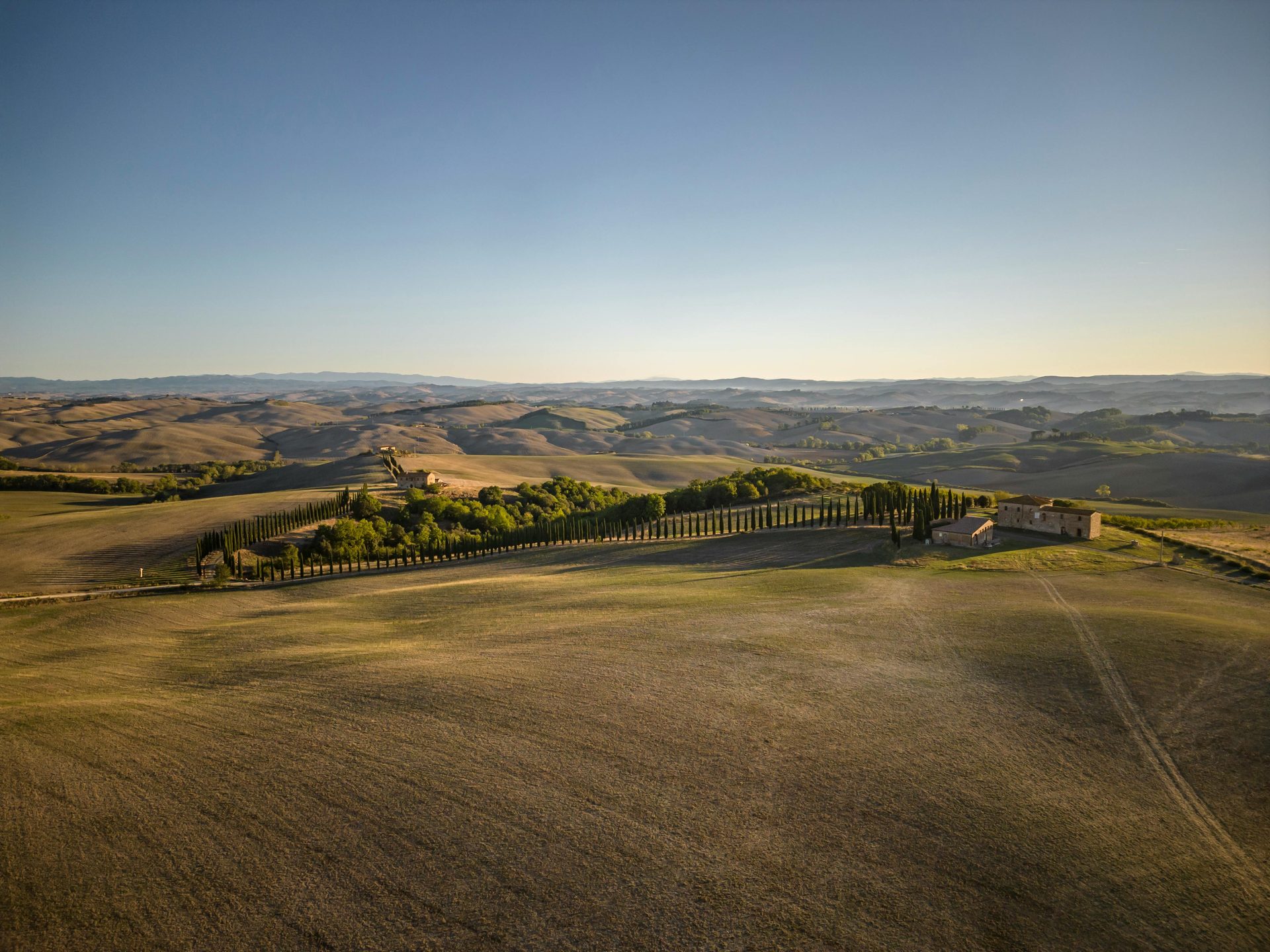
The Val d’Orcia has been a UNESCO World Heritage landscape since 2004, and that status decides the shape of its property market: no new house gets built, while demand rises year on year. The supply is the existing stock of farmhouses, and it does not grow.
The valley covers five municipalities south of Siena and costs noticeably less than Chianti for a landscape under the same level of protection. Prices move upward on a slow grade, without the swings of the coastal markets. For a buyer weighing zones, that combination of lower entry and structural scarcity is the case for the Val d’Orcia.
What does a Casale in the Val d’Orcia cost?
A renovated Casale with pool in a panoramic position runs 1.2 to 2.5 million euros. In premium locations near Pienza, with views over the Crete Senesi or Monte Amiata, that works out to 5,000 to 7,500 EUR/m²; in average positions, 3,000 to 4,500 EUR/m². Both figures sit well below the 3,500 to 5,500 EUR/m² that renovated Casali fetch in Chianti Classico.
An unrenovated Casale of 500 to 800 m² costs 300,000 to 700,000 euros, with renovation at 1,500 to 2,500 EUR/m². Take a 500 m² ruin at 400,000 euros: add the renovation and the total budget lands at 1.15 to 1.65 million, below the price of a comparable finished house. The catch is time, 12 to 24 months, and an architect who knows the heritage-approval process. Properties listed beyond twelve months and properties that come to market in winter tend to leave more room; how much room depends entirely on the individual house, and I work through that with each buyer.
Who buys in the Val d’Orcia?
| Origin | Typical segment | Budget | Trend |
|---|---|---|---|
| Germany / Austria / Switzerland | Casale, second home | 500k-2M | Stable, conservative decision-making |
| USA | Villa / Tenuta | 1.5-3M | Growing sharply since 2022 |
| UK | Casale, second home | 500k-2M | Stable, post-Brexit visa constraints |
| Italy (Milan, Rome) | Agriturismo / Tenuta | 1-3M | Steady, investment-focused |
Buyers from Germany, Austria, and Switzerland have come to the Val d’Orcia since the 1990s: typically a second home, budget 500,000 to 2 million euros, usually a renovated Casale with pool. Swiss buyers decide more conservatively and ask for full documentation before a first viewing. US buyers have grown sharply since 2022, drawn by Italian heritage, the dollar, and remote work; budgets often run 1.5 to 3 million. UK buyers have a long history in Tuscany but now need a visa for stays beyond 90 days, which has slowed some second-home purchases. Italian buyers from Milan and Rome take Agriturismo projects or Tenute as investments, a smaller but steady share.
What stands out in the Val d’Orcia market now
Demand is rising faster than prices, but the inventory still absorbs it. That is the key difference from Chianti, where renovated Casali are scarce. The Val d’Orcia still offers unrenovated Casali below 500,000 euros, a pool that narrows steadily and fastest in the municipalities with the best infrastructure: Pienza, Montalcino, San Quirico. The one segment running ahead of the average is the renovated Casale in a panoramic position, where the number of properties is finite and prices reflect it.
Montalcino is the other live story, carried by Brunello. The wine’s international name draws buyers who had never weighed the valley before. Residential prices in the town still sit below Pienza, roughly 2,347 against 2,982 EUR/m², but the vineyard land around it is a separate market: productive Brunello DOCG vineyard is valued on its own terms, and a Tenuta with Brunello rights is a business, not a house.
How the municipalities compare on price
Price differences inside the valley are wide: Bagno Vignoni costs a multiple of Radicofani. The split runs along infrastructure and tourism, not distance alone.
| Municipality / Hamlet | EUR/m² (average) | Character |
|---|---|---|
| Pienza | ~2,982 | UNESCO core town, Pecorino cheese, tourism, compact historic centre |
| Bagno Vignoni (San Quirico) | 3,000-3,800 | Thermal springs, very limited inventory, niche market |
| Montalcino | ~2,347 | Brunello prestige, winemaking, stable international demand |
| San Quirico d'Orcia | 1,474-3,739 | Wide range; Bagno Vignoni pushes the ceiling |
| Castiglione d'Orcia | ~1,800 | Quieter, less tourism, good entry prices |
| Radicofani | ~1,468 | Most remote, cheapest, fortress village at 780 m elevation |
Pienza (2,100 residents) is the best-known town in the valley, with the old town in the UNESCO core and a Pecorino that carries its name abroad. Infrastructure is solid for its size, and Montepulciano with its small hospital sits 15 minutes away. Prices in and around Pienza top the valley at about 2,982 EUR/m² on average, with little negotiation room where old-town proximity and views combine.
Montalcino (5,000 residents) runs on Brunello, which has put the town on the international map, particularly for American and Swiss buyers. Residential prices sit below Pienza at about 2,347 EUR/m² because the town is less tourism-driven and the infrastructure thinner, but the vineyard land around it is expensive and valued separately. A Tenuta with Brunello rights is a business. Two supermarkets, a pharmacy, doctors, and a primary school cover daily life; the Fortezza holds the centre.
San Quirico d’Orcia (2,800 residents) holds the widest spread of the five, 1,474 to 3,739 EUR/m². The reason is Bagno Vignoni, the hamlet with the medieval thermal pool on its square, a niche market where fewer than 20 properties come up a year and prices sit well above the rest. Remove that hamlet and San Quirico starts around 1,500 EUR/m². Castiglione d’Orcia (2,200 residents) sits off the tourist routes with good entry prices near 1,800 EUR/m² and Poderi scattered across a large territory; it offers the best landscape-to-price ratio after Radicofani for a buyer who accepts a 25-minute drive to Montalcino or Pienza.
Radicofani (1,100 residents) is the southernmost and cheapest point, about 1,468 EUR/m², its fortress at 780 metres visible from 30 kilometres off. For a buyer after solitude who does not mind a 30-minute drive to a larger town, it carries the strongest price-to-landscape ratio in southern Tuscany; for anything beyond a grocery store and a bar, the nearest options are Siena or Chiusi. Which hamlets are catching up and where the gaps still sit is best worked out directly. Get in touch.
Getting there and living with the distances
| From | Siena | Florence | FLR Airport | Chiusi Station | A1 Motorway | Hospital |
|---|---|---|---|---|---|---|
| Pienza | 55 | 110 | 115 | 30 | 30 (Chiusi) | 15 (Montepulciano) |
| Montalcino | 45 | 100 | 105 | 40 | 40 | 20 (Montepulciano) |
| San Quirico | 50 | 105 | 110 | 35 | 35 | 20 (Montepulciano) |
| Bagno Vignoni | 55 | 110 | 115 | 35 | 35 | 25 (Montepulciano) |
| Castiglione d'O. | 60 | 115 | 120 | 35 | 35 | 30 (Montepulciano) |
| Radicofani | 70 | 130 | 135 | 25 | 25 (Chiusi) | 35 (Montepulciano) |
The Val d’Orcia needs a car. The high-speed train (Frecciarossa) runs from Bologna or Rome to Chiusi-Chianciano Terme, then 25 to 40 minutes by road; Florence airport is 100 to 120 minutes out, with direct flights from across Europe, including London, Paris, and Munich. Perugia airport sits 60 to 90 minutes away. Many buyers drive down and use the house for extended weekends or pair it with two to three weeks in summer.
Daily life runs in Italian. English works in restaurants and hotels in Pienza and Montalcino, but not with tradespeople, the municipality, or the doctor, so a buyer on site six to eight weeks a year needs someone local. Pienza and Montalcino stay lively year-round; Radicofani and Castiglione go quiet in winter, when some restaurants close for two to four months. Fibre reaches the centres of Montalcino and San Quirico at 50 to 100 Mbit, but three to eight kilometres out it falls to 10 to 30, and in Radicofani and remote Poderi it can be weak, so check the specific address before buying if you work remotely. The nearest hospital is Montepulciano, 15 to 35 minutes depending on the town, or Siena Le Scotte at 45 to 70. A caretaker for garden, pool, and winter checks runs 300 to 600 euros a month. One feature sets this valley apart: three thermal areas at Bagno Vignoni and San Filippo, a density no other Tuscan property zone matches, which holds value for a wellness-minded buyer and lifts year-round rental demand near the springs.
Property types and price ranges
| Type | Price range | Size / Land | Typical location |
|---|---|---|---|
| Casale (renovated) | 1.2-2.5M EUR (5,000-7,500 EUR/m²) | 200-400 m² | Pienza, Montalcino, panoramic positions |
| Casale (unrenovated) | 300-700k EUR | 500-800 m² | All municipalities, especially Castiglione and Radicofani |
| Podere | 500k-1.5M EUR | 2-5 ha land | Scattered between towns |
| Agriturismo | 1-3M EUR | 5-15 ha land | Montalcino, San Quirico, Castiglione |
| Tenuta with vineyard | 2-5M EUR+ | 10-40 ha land | Montalcino (Brunello DOCG), south of Pienza |
An operating Agriturismo is a business, not a house: booking history, reviews, established guest flows, and a licence tied to agricultural use. What it earns should be checked against the real booking figures before purchase. A renovated Casale with views near Pienza commands a considerably higher EUR/m² than a part-renovated Podere near Castiglione with more land but a remoter position, and an Agriturismo near Montalcino with its own Brunello vineyard is valued on the business, the land, and the wine rights, with the living area secondary. More in the Agriturismo guide. For the specific considerations that come with buying a Podere, including land rights and agricultural constraints, see the Podere buying guide.
What pushes Val d’Orcia prices up and down
Three factors lift a price here. Panoramic views over the Crete Senesi or Monte Amiata are the product in this valley; a Casale with a wide panorama is worth considerably more than the same house with restricted sightlines. Walking distance to Pienza or Montalcino carries a clear premium over a 15-minute drive. A fully restored house with pool and energy class B or better commands a premium, because most buyers do not want a construction site and pay for the finished result.
Three factors pull a price down. An unpaved access road is more common here than in Chianti and affects both convenience and resale. No connection to the public water network, a well or cistern instead, affects isolated Poderi in Castiglione and Radicofani. And anything beyond 20 minutes by car to the nearest town weighs on liquidity; in Radicofani and southern Castiglione, properties sit 25 to 35 minutes from the nearest grocery store. See what is currently available on the property page.
When to view and when to negotiate
The valley runs on a clear calendar. New listings appear from February to April, peaking in March. April to June brings the first viewing wave, with the spring landscape and the April poppy bloom drawing many buyers to the area for the first time. July and August are decision months: buyers on holiday commit, and preliminary contracts cluster here. September and October bring a second wave during the grape harvest, with the villages alive; these are the months I recommend for viewings, because the valley shows itself as it is.
The quiet months from November to February carry the widest negotiation room: less competition, a stronger position. At least one winter visit is worth it. At two degrees you see the house without the summer filter, the heating gets tested, the access road shows what it does in rain. A common sequence: first contact in winter, viewings in spring near Pienza and Castiglione, a longer summer stay to test the area, then an offer at year-end on a property that had drawn no bid since spring, with about a year from first call to keys. Get in touch.
What UNESCO protection means for the buyer
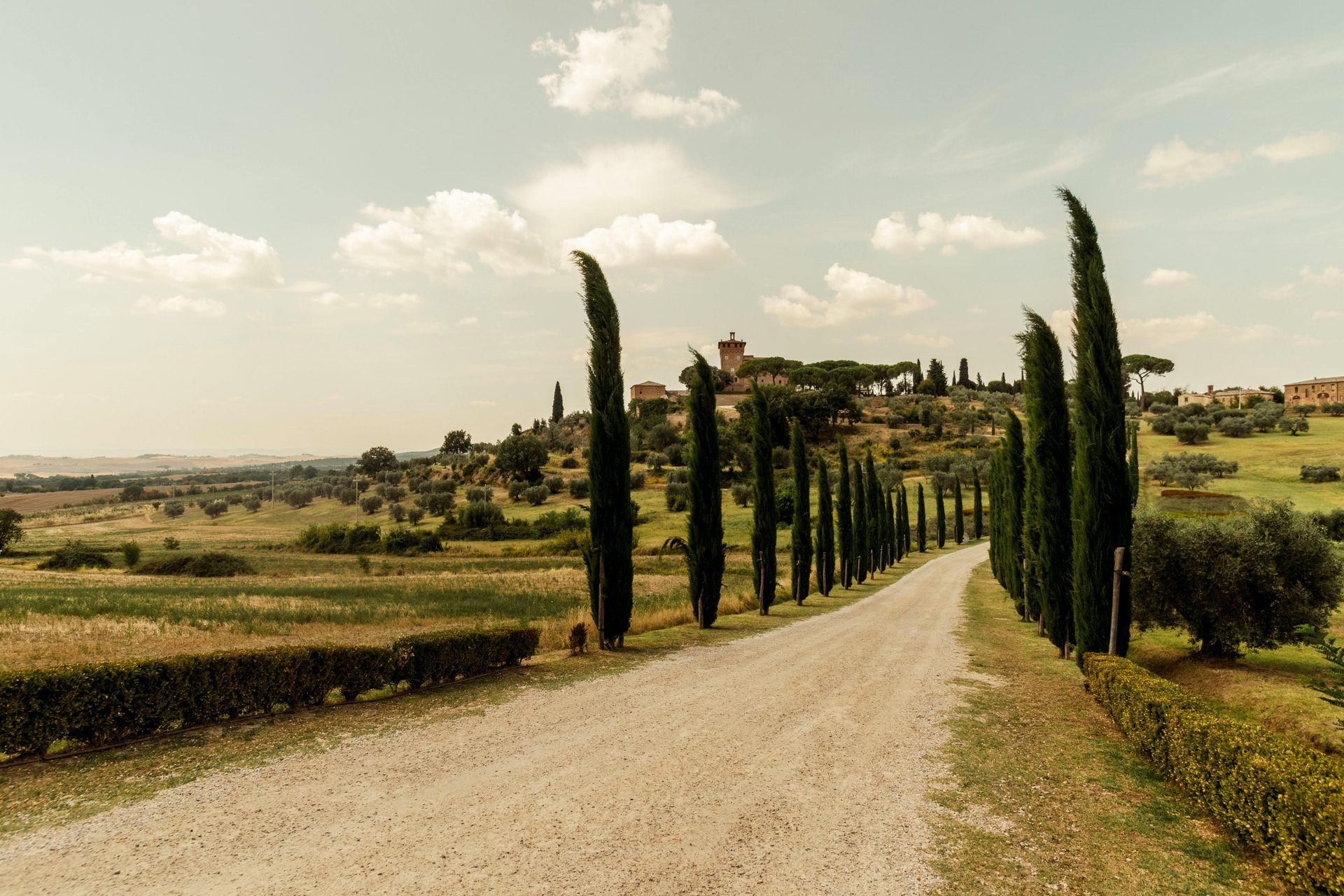
UNESCO status, held since 2004, decides three things that matter to a buyer. New construction is effectively blocked: building projects go through the heritage authority and new houses are typically refused, so supply stays limited to existing structures. Renovation needs approval, with exterior changes, facades, roofs, windows, pools, driveways, reviewed in a process that takes 60 to 120 days; visible rooftop solar and off-palette facade colours are usually refused. And the landscape stays put. The view across the cypress avenue will look the same in 20 years, because no neighbour can build a three-storey house on the adjacent lot.
The market effect is price stability. Limited supply and a block on new construction create a natural floor, and over the past decade the valley has shown less price volatility than comparable zones without the status. For a buyer thinking in decades, that is the point. Purchase costs are otherwise standard for Tuscany: registration tax of 9 per cent on the cadastral value for a second home, 2 per cent for a primary residence, plus notary and agent fees. The one extra is due diligence, where the surveyor must verify heritage-authority compatibility, adding 1,000 to 3,000 euros over a zone without protection. Full process in the Italy buying guide. For how the valley sits among the other zones, see where to buy in Tuscany and the 2026 market overview.
FAQ: buying in the Val d’Orcia
Is the Val d’Orcia cheaper than Chianti?
Yes, noticeably so on average. A renovated Casale with pool costs 1.2 to 2.5 million euros here against 1.5 to 3.5 million in Chianti, for a landscape under the same level of protection. The gap narrows at premium positions like Pienza or Bagno Vignoni, where limited supply pushes prices toward Chianti levels.
Can international buyers purchase property in the Val d’Orcia?
Yes. EU citizens buy without restriction, Swiss buyers under a reciprocity arrangement that works in practice, and US and UK buyers face no threshold. There is no visa requirement and no investor minimum. A purchase does not by itself grant residency, which is a separate process. More in the Italy buying guide.
How long does the buying process take?
From the first offer to completion at the notary, typically three to six months. Due diligence in the Val d’Orcia sometimes runs longer than elsewhere, because the heritage authority gets involved on approval questions tied to the UNESCO status. The agent coordinates the surveyor, notary, and any approvals so the timeline holds. More on the buyer advisory service.
Can I renovate a Casale freely in the Val d’Orcia?
Within limits. Interior work is more flexible, but exterior changes, roof, facade, windows, pool, driveway, need heritage-authority approval under the UNESCO protection. Rooftop solar is usually refused; ground-level installations in the garden are sometimes approved. Build the approval timeline into the budget from the start. More in the renovation guide.
Which Val d’Orcia town fits my profile?
Montalcino for wine and international recognition, Pienza for walkability and cultural life, Bagno Vignoni for thermal springs though inventory is very thin, and Castiglione d’Orcia or Radicofani for the lowest entry prices and the most quiet. The right answer turns on how much infrastructure you need against how remote you are willing to live. Best worked out directly. Get in touch.
Is there rental income potential in the Val d’Orcia?
Yes. Holiday lets earn solid daily rates in the long high season from April to October, and an operating Agriturismo more. Whether it pays in a given case depends on occupancy, position, and running costs, and only the specific calculation answers it. The flat tax on rental income (cedolare secca) is usually more favourable than the progressive rate. More in the rental guide.
Andrej Avi is an estate agent in Tuscany who guides international buyers from the first call to the notary appointment. Buying guidance · Properties · About Andrej
As of July 2026. General information, not legal or tax advice.